In the shadowy corridors of India’s prison system, a silent tragedy unfolds daily. Over 1,650 children live behind bars—not because they’ve committed any crime, but simply because they were born to incarcerated mothers. These children, innocent yet imprisoned, represent the cruel intersection of justice and neglect, caught in a system that repeatedly promises reform but consistently fails to deliver.
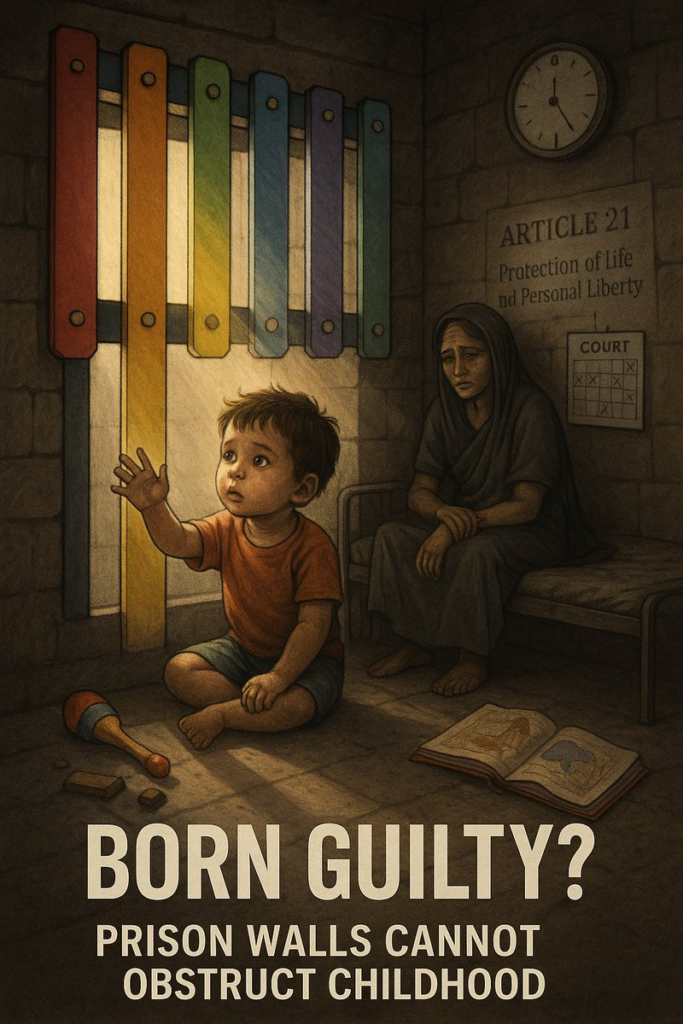
“Prison Walls Cannot Obstruct Article 21”
“Prison walls cannot obstruct the onrush of the fruits of Article 21 for children.” These powerful words from the Allahabad High Court’s recent verdict in Smt Rekha v. State of UP (2025) encapsulate the fundamental constitutional promise made to these children. The case centered on a rejected bail application from an incarcerated mother of a five-year-old child completely dependent on her. While dismissing the mother’s plea, the court recognized something more profound—the systemic failure that forces children into prisons where their fundamental rights to dignity, healthcare, and education are routinely neglected.
As Justice Bhanot eloquently observed, “The collateral damage inflicted upon a child as a result of denial of bail to their parent becomes most significant when the child has to reside in prison with the accused parent.” This statement cuts to the heart of a legal paradox: in protecting society from alleged wrongdoers, the system creates innocent victims of its own.
Empty Promises: From Upadhyaya to Rekha
The tragic reality is that this isn’t the first judicial acknowledgment of the problem. In 2006, in the landmark case of RD Upadhyaya v. State of Andhra Pradesh, the Supreme Court established comprehensive guidelines for the care and treatment of children living in prisons. The Court mandated development initiatives, systematic medical care, education, and specialized housing for these children.
Yet nearly two decades later, the Rekha case exposes that little has changed. The same issues, the same constitutional clauses, and the same unresolved problems have resurfaced with disturbing persistence. Prison conditions continue to deprive children of proper educational facilities, despite the Right to Education being recognized as a fundamental right under Article 21-A since 2009.
As Justice Bhanot rightly observed, “Neglect of rights of children who suffer from such default confinement in jail will reflect the failure of the State and inadequacy of the judicial process.” This statement is not merely a legal observation but a damning indictment of institutional apathy.
The Psychological Price of Imprisonment
Perhaps most disturbing is what we’ve learned from research conducted in the aftermath of these judicial pronouncements. A 2015 psychological study on children of incarcerated women in Uttar Pradesh paints a harrowing picture of reality that contradicts the promised reforms.
The research revealed that “children in the prison struggled through numerous deficiencies that included nutrition, medical care, housing, schooling, and recreation,” despite the Supreme Court’s clear directions in RD Upadhyaya. More profoundly, it confirmed what should have been obvious: “a prison won’t ever offer a family atmosphere…children who reside with incarcerated mothers are in no way different compared to other children.”
Even more revealing was the finding that “kids who meet their parents who have separated on a frequent schedule exhibit greater emotional adaptation, greater I.Q. scores, and greater behavioural adjustment compared to those who do not.” This research underscores that these children not only need their parents but also need normalized interaction outside prison walls.
The Ticking Clock of Lost Childhood
For children outside the prison whose parents are incarcerated, time becomes “a slow, cruel ticking clock of starvation, apprehension and being abandoned.” The Tata Institute of Social Sciences (TISS) project called Prayas in Byculla Prison further investigated these conditions. When asked by the Allahabad High Court in Bachchey Lal v. State of UP (2014) to evaluate the circumstances of inmates in Uttar Pradesh, their findings echoed the 2015 psychological study’s dismal conclusions.
The High Court’s subsequent rulings reaffirmed several critical requirements that remain largely unimplemented:
- Special dwelling units for children of incarcerated parents
- Improved dietary and health offerings
- A methodical framework for cooperation among probation officers, pediatric welfare organizations, and prison administration
- Regular inspections to verify compliance with legal requirements
Prayas’ advocacy did lead to the Galabhet Programme (2016), allowing incarcerated mothers and their children to interact in person rather than through dehumanizing glass partitions. Yet this represents only a small victory in a much larger battle for these children’s rights.
The Evolution of Children’s Rights in Prisons
The journey toward recognizing children’s rights in confinement has been long and arduous. In 1987, the Supreme Court decision in Sheela Barse v. Children’s Aid Society broke open the closed door around conditions in observation homes. The Court established revision guidelines, emphasizing that children should not be seen as helpless objects of pity but as unique individuals with enforceable freedoms.
More recently, in Re: Right to Privacy of Adolescents (2023), the Supreme Court addressed concerns about children living with parents imprisoned under the Protection of Children from Sexual Offences (POCSO) Act. The Court determined that under Section 2(14) of the Juvenile Justice Act, these children must be identified as needing protection and care. Importantly, the ruling clarified that the State must intervene if a parent is deemed unsuitable to raise a child.
Rule 339(f) now requires children older than four to attend educational institutions outside prisons—a significant step toward normalizing their lives. More importantly, it eliminates parental choice; incarcerated parents cannot refuse to send their children to school. As the regulation firmly states: “Every child residing in jail with their parents will be compulsorily admitted to school.”
Children Growing Up Forgotten
The stark statistics tell a disturbing story: 27.5% of children incarcerated in Maharashtra alone have been identified as underweight. While the UP Jail Manual of 2022 mandates that jails include nurseries and crèches, the reality on the ground tells a different story.
The advocacy organization Prayas continues to fight for improved protections. In 2017, their PIL in the Bombay High Court led to orders protecting the property rights of arrested women, helping prevent homelessness after release. Yet the pattern of systemic indifference persists.
As Justice YK Sabharwal famously commented, these children “have to stay in jail with their mothers, through no fault of their own.” This observation cuts to the heart of the matter—these are innocent victims of a system that seems incapable of finding alternatives.
The truth remains inescapable: these children don’t only grow up in jails; they grow up forgotten. They represent not just a failure of prison policy but a moral failure of our society to protect its most vulnerable members. Until meaningful implementation of court guidelines takes place, the gap between judicial promises and prison realities will continue to claim these innocent childhoods.
The question remains: how many more generations of children must grow up behind bars before we transform judicial rhetoric into meaningful reform?