The Porcelain Gambit: Taiwan’s Pivotal Role in the New Great Game

In the grand chessboard of Indo-Pacific geopolitics, the smallest pieces often determine the outcome. Taiwan may not be a queen or a rook, but its position makes it the decisive pawn upon which the entire game may turn.

When a Small Island Carries the Weight of a World Order

Picture a delicate Ming dynasty vase balanced precariously on the edge of a table. Now imagine two rivals circling that table, each claiming ownership of the vase, each calculating how to secure it without causing it to shatter. This, in essence, is the Taiwan situation – except the vase contains not just artistic heritage but the semiconductors powering our digital lives and the strategic fulcrum upon which the balance of global power now teeters.

As geopolitical tensions escalate across the Indo-Pacific, Taiwan has emerged as more than just another potential flashpoint in an increasingly contentious region. It has become the pivot point that will determine whether American-led deterrence still carries weight in the 21st century or whether we are witnessing the early stages of a fundamental realignment of global power.

The high-stakes nature of this standoff cannot be overstated. Taiwan represents a test case for what foreign policy experts have dubbed “integrated deterrence” – a fancy term for “using every tool in the toolbox simultaneously.” But as any handyman will tell you, having a toolbox full of tools is useless if you can’t coordinate their use effectively or if your opponent doesn’t believe you know how to use them.

Deterrence: It’s Not Just About Weapons Anymore

In the Cold War era, deterrence was relatively straightforward: nuclear weapons created a balance of terror that made direct confrontation between superpowers unthinkable. Today’s deterrence is infinitely more complex – a multi-dimensional chess game played simultaneously across military, economic, technological, cyber, and diplomatic domains.

Think of integrated deterrence as a sophisticated home security system rather than a single guard dog. It combines visible defenses (naval deployments), economic alarm systems (sanctions preparations), cyber tripwires (defensive and offensive capabilities), and neighborhood watch programs (alliance coordination). The theory holds that this multilayered approach makes the cost of aggression prohibitively high, thereby preventing conflict.

But there’s a glaring weakness in this logic. As anyone who has struggled with a smart home setup knows, the more complex the system, the more points of potential failure. Integrated deterrence suffers from what engineers call “integration complexity” – the challenge of making multiple systems work together seamlessly, especially under pressure. If your smart doorbell doesn’t communicate properly with your security lights during a break-in, the whole system becomes ineffective.

This is where Taiwan enters the equation. As former President Donald Trump reportedly engages in tariff talks with China, pursuing what he calls “a total reset” in trade relations, the contradiction between economic interdependence and military deterrence becomes painfully apparent. How can one part of the U.S. government threaten economic sanctions while another part negotiates trade deals? This cognitive dissonance isn’t lost on strategists in Beijing, who might reasonably question whether American deterrence is as integrated as advertised.

The Taiwan Calculus: More Than Just Cross-Strait Relations

Taiwan’s strategic significance extends far beyond its immediate relationship with mainland China. It sits at the center of what military planners call the “First Island Chain” – a series of islands (including Japan, the Philippines, and Indonesia) that effectively control maritime access to the Western Pacific. Control of Taiwan would give China the ability to project power into the Pacific unhindered, fundamentally altering regional security dynamics.

But Taiwan’s importance isn’t just geographical – it’s technological and symbolic as well.

Taiwan Semiconductor Manufacturing Company (TSMC) produces roughly 90% of the world’s advanced semiconductors – the brains behind everything from smartphones to military systems. This gives Taiwan an importance to the global economy disproportionate to its physical size. If Ukraine is the breadbasket of Europe, Taiwan is the silicon foundry of the digital world. Any disruption to this supply chain would send shock waves through the global economy, affecting industries from automotive to artificial intelligence.

Symbolically, Taiwan represents a critical test case for democratic resilience in the face of authoritarian pressure. As a vibrant democracy with cultural ties to China, Taiwan stands as a living counterargument to the notion that Chinese cultural heritage is somehow incompatible with democratic governance. This makes Taiwan not just a strategic piece on the chessboard but an ideological challenge that the Chinese Communist Party finds particularly difficult to ignore.

The Alliance Architecture: Building a House of Cards or a Fortress?

The U.S. has been busy reinforcing its alliance system around Taiwan, with Japan emerging as the critical partner. Japan’s 2022 National Security Strategy explicitly linked Taiwan’s security to its own – a significant shift for a country historically cautious about regional security commitments. This has translated into Japan’s largest defense spending increase since World War II and growing operational coordination with American forces.

The Philippines, after years of hedging between the U.S. and China under former President Rodrigo Duterte, has reembraced its alliance with the United States. The Enhanced Defense Cooperation Agreement (EDCA) allows American forces to preposition assets on Philippine territory – placing them much closer to Taiwan than Guam or other American territories. This creates what military planners call “strategic depth” – the ability to operate from multiple locations rather than a few vulnerable bases.

Trilateral coordination frameworks linking the U.S. with various combinations of Japan, Australia, the Philippines, and South Korea have strengthened intelligence sharing and operational planning. The Quad grouping (the U.S., Japan, Australia, and India) provides another layer of coordination, even if it’s not formally a military alliance.

However, this alliance architecture resembles an elaborate house of cards in one crucial respect: its stability depends on the reliability of each component. If any major ally wavers in a crisis – perhaps due to Chinese economic pressure or domestic political considerations – the entire structure could collapse. Alliance credibility depends not just on capabilities but on the perception that those capabilities will actually be used when needed.

India’s Strategic Ambiguity: The Elephant in the Room

While Japan, Australia, and others have moved increasingly into alignment with the U.S. position on Taiwan, India maintains what might be called “strategic ambiguity squared” – ambiguity about its position on an issue where the U.S. itself maintains strategic ambiguity.

India has quietly expanded economic and diplomatic ties with Taiwan but remains wary of overt involvement in Taiwan-related security issues. This caution stems from India’s own complex relationship with China – the two countries have been locked in border tensions since a deadly clash in 2020, yet maintain significant economic ties.

India’s position illustrates a broader dilemma facing many regional powers: balancing security concerns about China’s assertiveness with economic dependence on the Chinese market. As one Indian strategist put it to me, “We want American security guarantees without American expectations of alignment.”

Yet India plays an indirect role in Taiwan’s security equation. By tying down Chinese military resources along their disputed Himalayan border, India reduces the forces Beijing could deploy in a Taiwan scenario. This “continental distraction” serves American interests without requiring explicit Indian commitment to Taiwan’s defense.

The Ukraine Mirror: Reflections and Distortions

Russia’s invasion of Ukraine offers both instructive parallels and potentially misleading lessons for the Taiwan situation. The West’s initially reactive posture – imposing sanctions and providing military aid only after the invasion began – gave Russia significant early advantages. Many analysts argue that stronger deterrent actions before the invasion might have prevented the conflict entirely.

Taiwan shares certain vulnerabilities with Ukraine: geographic isolation, dependence on external support, and an adversary with overwhelming local military superiority. However, the differences are equally significant. Taiwan is an island, making invasion logistically challenging. Its semiconductor industry gives it economic leverage Ukraine lacked. And China is far more integrated into the global economy than Russia, making it potentially more vulnerable to economic pressure.

The key lesson from Ukraine may be the importance of preparation rather than reaction. Integrated deterrence cannot be assembled hastily during a crisis – the components must be tested, coordinated, and credible long before tensions escalate. Otherwise, the deterrent effect evaporates precisely when it’s most needed.

The Trump Factor: The Unpredictable Variable

Adding another layer of complexity is the return of Donald Trump to the White House. His preference for transactional diplomacy and business-oriented deal-making introduces significant uncertainty into the deterrence equation.

Trump’s recent claim of pursuing “a total reset” in trade relations with China following tariff talks in Geneva reflects his emphasis on economic relations sometimes at the expense of security considerations. This approach creates potential contradictions in the integrated deterrence framework – how can economic pressure be a credible deterrent if it’s simultaneously being used as a bargaining chip in trade negotiations?

Strategic ambiguity requires disciplined messaging to be effective. When signals become contradictory or unpredictable, adversaries may see opportunity rather than risk. In game theory terms, if your opponent can’t predict your response, they may gamble on your restraint rather than assuming your intervention.

The Economic Stakes: Betting the Global House

If the strategic stakes weren’t high enough, the economic consequences of a Taiwan crisis would be catastrophic. A disruption to Taiwan’s semiconductor production would create ripple effects throughout the global economy, affecting everything from automobile production to cloud computing. One study estimated that a one-year disruption could cost the global economy over $1 trillion.

This economic interdependence creates its own form of deterrence – what some have called “silicon shield” theory, the idea that China wouldn’t risk destroying an industry so vital to its own technological development. However, this assumes rational calculation of economic self-interest would prevail over other considerations in a crisis.

Taiwan’s economic significance does offer leverage in building international support. Countries that might be reluctant to take sides in a U.S.-China confrontation have concrete interests in Taiwan’s continued stability as a semiconductor supplier. This creates potential for broader coalitions beyond traditional U.S. allies.

Beyond Kinetic Conflict: The Information Battlefield

While much analysis focuses on potential military scenarios, the Taiwan situation is already an active battlefield in the information domain. China’s comprehensive pressure campaign includes cyberattacks, disinformation operations, and psychological warfare designed to wear down Taiwan’s resistance and sow divisions among its supporters.

These non-kinetic approaches represent what strategists call “gray zone” tactics – aggressive actions that stay below the threshold of conventional warfare but steadily erode the status quo. They present particular challenges for deterrence because they don’t trigger clear red lines and their cumulative effect may only become apparent over time.

Effective deterrence must address these threats as seriously as conventional military scenarios. This requires enhanced cyber defense capabilities, coordinated counter-disinformation strategies, and resilience-building measures that can withstand persistent pressure over years or decades.

The Fulcrum Effect: How Small Islands Shape Great Power Politics

Taiwan’s outsized importance in the emerging great power competition reflects what might be called “the fulcrum effect” – the way relatively small geographic positions can leverage disproportionate influence when positioned at critical junctures.

Throughout history, control of key maritime chokepoints and island positions has often determined the fate of empires. From British control of Gibraltar to American influence in Panama, the ability to secure strategic positions has shaped global power distribution. Taiwan represents perhaps the most significant such position in the contemporary world.

What makes Taiwan unique is that it combines geographic, technological, and symbolic significance in a single package. It’s not just a military position, an economic asset, or a political symbol – it’s all three simultaneously. This creates a density of strategic importance unmatched anywhere else in the world.

The Way Forward: From Conceptual Deterrence to Operational Reality

For integrated deterrence to be more than an academic concept, it must translate into concrete operational capabilities. This requires addressing several critical challenges:

1. Coordination Mechanisms: Effective crisis response demands seamless coordination across military, economic, cyber, and diplomatic domains. This requires not just interagency processes within governments but international coordination frameworks that can operate under pressure.

2. Resilience Building: Taiwan’s own defensive capabilities and societal resilience represent the first line of deterrence. Strengthening these reduces the likelihood that deterrence will be tested.

3. Cost Imposition Clarity: Potential aggressors must understand precisely what costs they would face across all domains. Ambiguity about response may be strategically useful in some contexts, but clarity about consequences enhances deterrent effects.

4. Avoiding Contradictions: Different elements of deterrence must reinforce rather than undermine each other. Trade policies that strengthen economic ties with China while simultaneously threatening economic sanctions create credibility problems.

5. Alliance Management: The perception that allies might defect in a crisis undermines deterrence before it’s tested. Managing alliance expectations and commitments requires constant diplomatic investment.

The Porcelain Imperative

Taiwan stands today as the proving ground for whether collective security arrangements can still function in an era of renewed great power competition. If deterrence holds, it could establish a foundation for a stable balance of power in the Indo-Pacific. If it fails, the consequences would reverberate throughout the international system, potentially triggering a cascade of security realignments.

The stakes extend far beyond Taiwan itself. At issue is whether a rules-based international order – imperfect as it may be – can accommodate the rise of new powers without descending into conflict, and whether democratic governments can coordinate effectively to meet authoritarian challenges.

In this sense, the delicate Ming vase on the edge of the table represents not just Taiwan but the fragile arrangements that have maintained relative peace and prosperity for decades. The challenge is not simply to prevent it from falling but to create conditions where no one feels compelled to grab for it in the first place.

As Brahma Chellaney aptly noted, Taiwan represents “the crucible in which the Indo-Pacific’s future security order will be forged.” What emerges from that crucible – a reinforced structure of collective security or a more fragmented and volatile region – will shape global politics for generations to come.

The ultimate test of integrated deterrence will not be measured in military hardware or diplomatic statements but in the most meaningful metric of all: whether it succeeds in preventing conflict rather than merely preparing for it. In that sense, boring stability would represent its greatest triumph.

About the author: Dr. Margaret Chen is a Distinguished Fellow at the Pacific Strategic Institute and former advisor to the Department of State on East Asian affairs. The views expressed are her own.
Why Emerging Markets Like India Are More Resilient to Global Shocks: Insights from Raghuram Rajan & Gita Gopinath

In an era of unprecedented global economic volatility—from pandemic disruptions to geopolitical tensions and climate challenges—a remarkable phenomenon has emerged: the surprising resilience of emerging market economies, particularly India. Two of the world’s most respected economists, Raghuram Rajan and Gita Gopinath, have offered valuable insights into this resilience. Their perspectives are particularly significant given their roles as former Reserve Bank of India Governor and current First Deputy Managing Director of the IMF, respectively.

The Evolution of Emerging Market Resilience

The global economic landscape has transformed dramatically over the past two decades. Emerging markets, once considered highly vulnerable to external shocks, have demonstrated remarkable stability during recent crises. This shift didn’t happen by accident but resulted from deliberate policy choices and institutional reforms.

According to Raghuram Rajan, emerging markets have undergone a fundamental transformation in their monetary policy approaches, making them significantly more resilient to global economic turbulence. This represents a major departure from historical patterns, where emerging economies were often the first casualties of global financial disruptions.

Gita Gopinath has similarly noted that emerging markets have shown “considerable resilience over these past few years” despite facing unprecedented shocks. She attributes this to “significant steps already taken over the last two decades to strengthen EM policy frameworks.”

Inflation Targeting: A Game-Changer

One of the most critical policy innovations has been the widespread adoption of inflation targeting frameworks by emerging market central banks. This approach, pioneered by advanced economies, has been adapted effectively to the unique challenges facing developing nations.

Gopinath has praised emerging markets for their robust monetary strategies, highlighting how “strong policy frameworks and commitment to inflation targeting have helped these economies navigate complex economic landscapes.” She emphasizes that “focusing on sound communication about committing to inflation, targeting on anchoring long-term inflation expectations” is “very critical for the emerging markets.”

This disciplined approach to monetary policy has yielded tangible benefits. Many emerging markets, including India, have successfully tamed the inflation demons that plagued them for decades. When global inflation surged following pandemic-related disruptions and the Russia-Ukraine conflict, these economies proved better equipped to manage price pressures than in previous cycles.

India’s Standout Performance

Among emerging markets, India has demonstrated particularly impressive resilience. Current projections show India maintaining growth above 6% (specifically 6.2% in 2025 and 6.3% in 2026) while many other economies struggle with lower growth rates. This performance is especially notable given that it outpaces China’s forecast by more than 2 percentage points.

Several factors contribute to India’s exceptional position:

  1. A robust monetary policy framework: The Reserve Bank of India has maintained policy credibility through disciplined inflation targeting, even during periods of political pressure.
  2. Domestic consumption strength: India’s large internal market provides a buffer against global trade disruptions.
  3. Digital infrastructure: The rapid development of digital public goods and financial inclusion has created new economic resilience.
  4. Demographic advantage: A young, growing workforce continues to drive economic expansion.

Rajan’s leadership at the RBI played a significant role in establishing the inflation targeting framework that has served India well. During his tenure (2013-2016), he emphasized the importance of price stability as a foundation for sustainable growth—a position that has been validated by subsequent events.

The Importance of International Coordination

While praising emerging markets’ improved resilience, both economists emphasize that no country is an island in today’s interconnected global economy. Rajan has been particularly vocal about the need for better international coordination among central banks.

At a Brookings Institution event, Rajan called for improved coordination, expressing concern that the Federal Reserve wasn’t paying sufficient attention to the ripple effects its policies have on emerging markets. He advocated for a “rules-based international framework” that would help countries “avoid policies with large spillovers, develop resilient markets, and benefit from capital flows while managing risks to financial stability.”

This perspective highlights a crucial point: while emerging markets have become more resilient, they remain vulnerable to decisions made in Washington, Frankfurt, and other global financial centers. Advanced economy central banks still tend to prioritize domestic mandates over international spillovers, creating challenges for emerging economies.

Three Pillars of Enhanced Resilience

Gopinath has outlined three broad strategies for emerging markets to further strengthen their resilience in the face of tougher external conditions:

  1. Boosting domestic resources: Improving tax collection, broadening the tax base, and enhancing public expenditure efficiency can create fiscal space for both development needs and crisis response.
  2. Enhancing financial system resilience: Building stronger regulatory frameworks, deepening local capital markets, and implementing macroprudential policies can reduce vulnerability to external financial shocks.
  3. Implementing sustainable climate strategies: Addressing climate vulnerabilities through adaptation and mitigation not only protects against physical risks but can unlock new growth opportunities.

These strategies recognize that resilience isn’t just about monetary policy but requires a comprehensive approach spanning fiscal, financial, and environmental dimensions.

The Role of Access to Finance

Beyond macroeconomic policies, Rajan’s research has highlighted another crucial element of resilience: access to finance. His studies on climate adaptation show that “enhancing access to finance can enable communities to adapt to large adverse climatic shocks, and limit migration.”

This insight has important implications for emerging markets facing various shocks. Financial inclusion and deep credit markets provide crucial cushioning mechanisms that allow households, businesses, and communities to weather external disruptions. India’s push for financial inclusion through initiatives like Jan Dhan Yojana aligns with this research-backed approach.

Democracy and Economic Resilience

Interestingly, Rajan has also emphasized the connection between democracy and economic resilience. In a speech at the Ideas for India Conference, he “argued that India’s democracy is the path to its economic growth,” suggesting that democratic institutions provide important checks and balances that contribute to sustainable economic development.

This perspective challenges simplistic narratives that sometimes portray authoritarian systems as more effective at implementing economic reforms. Instead, Rajan’s view suggests that democratic debate, while sometimes messy, ultimately produces more durable and resilient economic institutions.

The Continuing Challenge of Global Economic Governance

Despite the progress made by emerging markets in building resilience, both economists highlight the ongoing challenges in global economic governance. Rajan has noted that if we are to “find ways to use capital flows well—to meet the saving needs of rich aging countries while also fulfilling the financing needs of developing and emerging market economies, without precipitating periodic crises—countries will have to temper their sovereign policymaking with their international responsibilities to avoid major spillovers.”

This vision calls for a more inclusive and balanced approach to global economic governance, where emerging markets have a greater voice in shaping the rules that affect them. The IMF, where both Rajan and Gopinath have served in leadership roles, has an important part to play in this evolution.

Conclusion: A Template for Resilience

The insights from Rajan and Gopinath provide a valuable template for understanding and enhancing economic resilience in an increasingly turbulent world. Their analysis suggests that emerging markets, far from being passive victims of global economic forces, can take concrete steps to strengthen their position.

The success stories of countries like India demonstrate that with the right policy frameworks—centered on disciplined monetary policy, financial sector development, and inclusive growth—emerging economies can not only withstand global shocks but continue to advance their development agendas.

As the world grapples with new challenges from technological disruption to climate change, these lessons in resilience will only grow more valuable. By combining macroeconomic discipline with structural reforms and inclusive development, emerging markets can continue their transformation from global economy vulnerability points to centers of stability and growth.

The perspectives of Rajan and Gopinath, grounded in both rigorous research and practical policy experience, offer guidance not just for emerging markets but for all economies seeking to navigate an increasingly complex and interconnected global economic landscape.

How India’s Foreign Policy Waltz Has Evolved From Nehru to Modi

A critical examination of India’s diplomatic evolution and its implications for the emerging world order

From Idealism to Pragmatism: The Great Pivot

In the chaotic aftermath of partition, as a newly independent India struggled to find its footing on the world stage, Jawaharlal Nehru crafted a foreign policy defined by moral righteousness and strategic ambiguity. Like a teenager determined to forge their own identity, India was adamant about not picking sides in the burgeoning Cold War. Non-alignment wasn’t merely a policy choice; it was practically embedded in the nation’s diplomatic DNA.

But as with most adolescent idealism, reality has a way of introducing uncomfortable complications.

Seven decades later, India’s foreign policy has undergone a transformation that would leave Nehru both impressed and perplexed. From the principled non-alignment of the Nehru era to the “multi-alignment” pragmatism of today’s India under Narendra Modi, this evolution tells a fascinating story of a nation’s journey from ideological purity to strategic flexibility.

Nehru’s Grand Vision: The Road Not Fully Traveled

When India achieved independence in 1947, the world was rapidly dividing into American and Soviet spheres of influence. Faced with this binary choice, Nehru opted for Door Number Three. His vision positioned India as a moral voice in international affairs – the conscience of the developing world, if you will.

Non-alignment under Nehru wasn’t simply refusing to join military blocs; it represented an ambitious attempt to create a third force in global politics. It was foreign policy as moral philosophy, with India positioning itself as the enlightened mediator rising above Cold War pettiness.

This approach had its merits. It preserved India’s autonomy during a period when many post-colonial states were becoming ideological battlegrounds. It elevated India’s stature among newly independent nations and provided the foundation for the Non-Aligned Movement. Nehru, with his aristocratic bearing and intellectual heft, became a respected voice at international forums, advocating for decolonization and nuclear disarmament.

Yet for all its moral appeal, Nehru’s foreign policy had significant blindspots. His idealistic handling of relations with China, epitomized by the “Hindi-Chini Bhai-Bhai” (Indians and Chinese are brothers) slogan, culminated in the humiliating 1962 border war. His trust in international institutions and norms proved somewhat misplaced regarding Kashmir, where UN resolutions failed to deliver the expected outcomes.

Perhaps the greatest criticism of Nehru’s approach was that it occasionally sacrificed pragmatic national interests at the altar of idealistic principles. In prioritizing a future world order based on cooperation rather than competition, Nehru sometimes overlooked immediate security concerns – a luxury a developing nation could ill afford.

Indira’s Iron Fist: Realpolitik Enters the Chat

If Nehru’s foreign policy was characterized by principled idealism, his daughter Indira Gandhi introduced a healthy dose of realpolitik to the mix. Under her leadership, India’s foreign policy acquired sharper edges and a distinctly pragmatic orientation.

The 1971 Indo-Soviet Treaty of Peace, Friendship and Cooperation marked a significant departure from non-alignment’s equidistance principle. When faced with an aggressive Pakistan backed by the United States, Indira didn’t hesitate to tilt toward Moscow. This strategic pivot proved crucial during the Bangladesh Liberation War, with Soviet diplomatic support shielding India from international pressure.

The 1974 “peaceful nuclear explosion” at Pokhran further demonstrated India’s willingness to assert itself, consequences be damned. While the test invited sanctions and technology restrictions, it established India’s scientific prowess and signaled its refusal to accept a discriminatory international nuclear order.

Indira’s approach to foreign policy was characterized by bold, sometimes impulsive decision-making. Where Nehru sought to influence through moral example, Indira aimed to project power – sometimes through dramatic gestures that prioritized immediate political gains over long-term strategic thinking.

Her handling of relations with neighboring states reflected this approach. Under her watch, India became the dominant regional power in South Asia, willing to intervene militarily (as in East Pakistan) or support friendly regimes (as in Sri Lanka). This “Indira Doctrine” effectively declared South Asia to be India’s sphere of influence – a significant departure from Nehru’s more cooperative vision of regional relations.

The Economic Turn: Narasimha Rao’s Quiet Revolution

When P.V. Narasimha Rao assumed office in 1991, India faced not just an economic crisis but an existential one. The collapse of the Soviet Union, India’s reliable partner, coincided with a balance of payments crisis that forced a fundamental reconsideration of both economic and foreign policy.

Rao, working with Finance Minister Manmohan Singh, initiated economic liberalization that would have profound implications for India’s international relations. The era of looking primarily to Moscow for support was over; India would now need to engage with a unipolar world dominated by the United States and its market-oriented ideology.

With characteristic subtlety, Rao initiated a foreign policy realignment without explicitly abandoning non-alignment’s rhetoric. His establishment of full diplomatic relations with Israel in 1992 – a step previously considered too politically sensitive – signaled a new pragmatism. Simultaneously, he launched the “Look East” policy, recognizing that India’s economic future was increasingly tied to the dynamism of East Asian economies.

Rao understood that in the post-Cold War world, economic heft would be the primary currency of international influence. His foreign policy innovations were less about grand gestures and more about positioning India advantageously in a rapidly changing global landscape. By linking foreign policy more explicitly to economic interests, he set the stage for the more assertive diplomacy that would follow.

Vajpayee’s Strategic Autonomy: Threading the Needle

If Narasimha Rao quietly laid the groundwork for a more pragmatic foreign policy, Atal Bihari Vajpayee built confidently upon this foundation while adding his own distinctive touches. A poet-statesman with deep strategic instincts, Vajpayee navigated India through perhaps its most challenging foreign policy period since independence.

The 1998 nuclear tests dramatically announced India’s arrival as a nuclear power while inviting international sanctions and isolation. Yet through patient diplomacy and strategic restraint, Vajpayee managed to transform a potential disaster into a diplomatic victory. By unilaterally declaring a moratorium on further tests and adopting a No First Use policy, he positioned India as a responsible nuclear power.

His handling of the Kargil conflict further demonstrated this combination of firmness and restraint. By limiting the conflict to the Line of Control despite provocation, Vajpayee showed that India could be trusted with its nuclear capability – a message aimed primarily at the United States.

Perhaps Vajpayee’s most significant contribution was his outreach to both the United States and China. His willingness to engage with the US despite ideological differences within his own party laid the groundwork for the transformation of Indo-US relations. Similarly, his approach to China – “we can change history but not geography” – recognized the necessity of engagement with a difficult neighbor.

Vajpayee’s foreign policy was characterized by a certain strategic clarity. He recognized that India’s rise would inevitably generate friction, but aimed to minimize it through transparent communication and restrained behavior. This approach – assertive about core interests while flexible on methodology – would be further developed by his successors.

Manmohan Singh: The Unlikely Bold Gambler

For a man often criticized as indecisive in domestic politics, Manmohan Singh displayed remarkable boldness in foreign policy. The civil nuclear agreement with the United States, which he pursued despite significant domestic opposition, represented the most consequential foreign policy initiative since the 1971 treaty with the Soviet Union.

The nuclear deal effectively ended India’s nuclear isolation without requiring it to sign the Non-Proliferation Treaty. More importantly, it signaled a fundamental realignment in Indo-US relations, transitioning from mutual suspicion to strategic partnership. That Singh, a lifelong believer in non-alignment, would champion this shift demonstrated his pragmatic recognition of changing global realities.

Singh’s approach to Pakistan revealed similar complexity. His willingness to consider out-of-box solutions on Kashmir and pursue dialogue despite terrorist provocations showed a statesman’s vision. That these initiatives ultimately failed due to Pakistan’s internal contradictions doesn’t diminish the boldness of the attempt.

Under Singh, India’s foreign policy became increasingly multi-directional. While deepening ties with the US, he simultaneously strengthened relations with Russia and initiated a structured dialogue with China. His “Look East” policy evolved into “Act East,” with India becoming a more active participant in East Asian institutions.

Perhaps Singh’s most significant contribution was bringing economic considerations to the center of foreign policy. As an economist, he understood that India’s global influence would ultimately depend on its economic performance. His emphasis on trade agreements, energy security, and diaspora relations reflected this understanding.

Modi’s Assertive Pragmatism: The Age of Multi-Alignment

If Manmohan Singh quietly recalibrated India’s foreign policy, Narendra Modi has pursued this recalibration with characteristic vigor and visibility. From his energetic outreach to the Indian diaspora to his personal diplomacy with world leaders, Modi has brought a new dynamism to India’s international engagement.

Modi’s approach represents the culmination of India’s journey from non-alignment to what might be called “multi-alignment.” Rather than maintaining equidistance from power blocs (as classical non-alignment advocated), India now builds issue-based coalitions depending on its interests. Thus, India can simultaneously deepen defense cooperation with the United States, purchase energy and weapons from Russia, and participate in the Shanghai Cooperation Organization with China.

This flexibility is particularly evident in India’s approach to challenging groupings. Whether it’s the Quad with the US, Japan, and Australia, or BRICS with Russia, China, Brazil, and South Africa, India participates without allowing any single arrangement to define its foreign policy. This “multi-alignment” represents a sophisticated adaptation to a more complex, multipolar world.

Modi has also displayed a new assertiveness in projecting India’s interests. The surgical strikes against terrorist launch pads in Pakistan-occupied Kashmir and the aerial strike on Balakot signaled a willingness to use force more overtly than previous administrations. Similarly, India’s firm stance during the Doklam standoff with China demonstrated a new confidence in handling difficult neighbors.

Perhaps the most significant aspect of Modi’s foreign policy has been his explicit linking of domestic transformation with international relations. Programs like “Make in India” and “Atmanirbhar Bharat” (Self-Reliant India) are presented not just as economic initiatives but as essential elements of national security and global influence.

The Road Ahead: Balancing Acts in a Fractured World

As India navigates an increasingly complex international landscape, several challenges loom large. The intensifying US-China rivalry presents both opportunities and risks, with pressure to choose sides likely to increase. Managing relations with an increasingly assertive China while preserving strategic autonomy will require sophisticated diplomacy.

Regional challenges persist, with an unstable Afghanistan, a hostile Pakistan, and China’s growing influence in South Asia complicating India’s immediate security environment. Climate change, with its potential for driving resource conflicts and migration, adds another layer of complexity.

Yet India also enjoys significant advantages. Its democratic credentials provide moral authority in a world increasingly divided between democratic and authoritarian models. Its demographic profile offers economic potential that few other major powers can match. Its geographical position at the crossroads of Asia gives it natural strategic importance.

The evolution of India’s foreign policy from Nehru to Modi reflects a gradual maturation – from the idealism of youth to the pragmatism of experience. Each leader has contributed distinct elements to this evolution: Nehru’s moral vision, Indira’s assertiveness, Rao’s economic pragmatism, Vajpayee’s strategic clarity, Singh’s focused engagement, and Modi’s energetic multi-alignment.

The challenge for India going forward will be to preserve the best elements of this tradition while adapting to a rapidly changing world. This will require balancing competing imperatives: power and principle, regional leadership and global ambition, strategic autonomy and necessary partnerships. It will demand a foreign policy that is simultaneously principled and pragmatic, assertive and adaptable.

In the great power dance of the 21st century, India has moved from wallflower to active participant. Its ability to execute increasingly complex diplomatic choreography while maintaining its balance will determine its place in the emerging world order. The journey from non-alignment to multi-alignment has been a remarkable evolution – but the dance continues, and the music is only getting more complicated.

An Enduring Balancing Act

The story of India’s foreign policy is ultimately one of adaptation without abandonment of core principles. From Nehru’s principled non-alignment to Modi’s pragmatic multi-alignment, there runs a common thread: the determination to preserve strategic autonomy while engaging with a complex world on India’s own terms.

This balancing act – between idealism and realism, between regional imperatives and global ambitions, between historical relationships and future necessities – defines the essence of India’s diplomatic tradition. It is a tradition that has evolved considerably over seven decades, yet remains recognizably Indian in its complexity, its contradictions, and its ultimate coherence.

As the current government continues to refine this approach, the ultimate measure of success will be whether India can translate its diplomatic engagements into tangible outcomes for its citizens. Foreign policy, after all, is not an end in itself but a means to secure the conditions for national development and well-being.

In that sense, the most significant development in India’s foreign policy might be the growing recognition that external and internal strength are inextricably linked – that India’s global influence will ultimately depend not just on diplomatic skill but on domestic transformation. It is a lesson that each prime minister has learned in their own way, contributing to a foreign policy tradition that continues to evolve with each generation.

Dr. Ananya Chatterjee is a Professor of International Relations at Delhi University and a former foreign policy advisor to the Government of India. The views expressed are personal.

Nuclear Neighbors and Impossible Choices

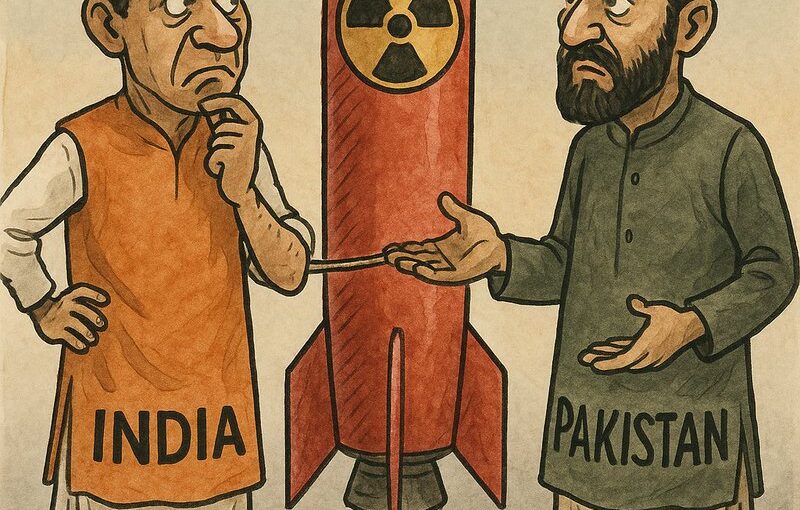
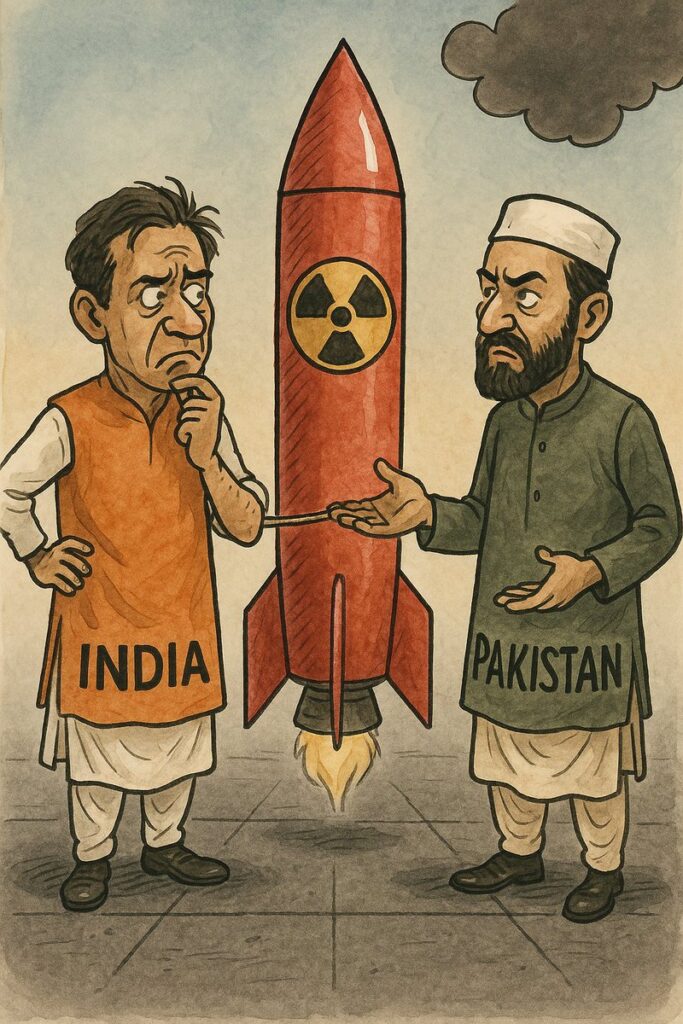
In the grand theater of geopolitics, few performances are as tragically repetitive as the India-Pakistan saga. The latest episode in this decades-long drama has once again brought two nuclear-armed neighbors to the precipice of disaster, with a fragile ceasefire currently holding by threads thinner than a politician’s promise.

The Ceasefire That Nobody Believes In

A week into the latest ceasefire, and already the spin machines are working overtime. Pakistan “welcomes” Donald Trump’s “mediation” — a claim that India dismisses faster than a cricket batsman facing a slow ball. India insists they halted hostilities purely out of the goodness of their hearts, responding to Pakistan’s desperate pleas. If diplomatic statements were subject to polygraph tests, we’d need machines with reinforced sensors.

Let’s be honest: this ceasefire isn’t a resolution; it’s merely an intermission. The tragic violence that sparked this round of hostilities hasn’t been addressed, and the fundamental causes remain as entrenched as ever.

Blood in Paradise

The spark that lit this particular powder keg was horrifyingly familiar. On April 22, the picturesque Pahalgam valley in Kashmir — a location whose beauty makes travel brochures weep with joy — became a scene of calculated brutality. Masked terrorists, with the cold efficiency of bureaucrats processing paperwork, separated tourists by religion and executed 26 non-Muslim men, mostly Hindus and Christians. Many were newlyweds, murdered in front of their wives who were deliberately spared to bear witness.

The Resistance Front quickly claimed responsibility — a group that India maintains is just another mask worn by Lashkar-e-Taiba (LeT), Pakistan’s not-so-secret terrorist proxy. It’s like claiming your destructive pet is actually a neighbor’s animal that just happens to sleep in your house, eat your food, and follow your commands.

The National Identity Crisis

Pakistan’s obsession with Kashmir is less about territory and more about existential validation. Born in 1947 as a homeland for the subcontinent’s Muslims based on the two-nation theory (the idea that Hindus and Muslims couldn’t coexist), Pakistan faced an immediate identity crisis when India stubbornly refused to become a Hindu state and instead embraced secularism.

Kashmir, with its Muslim majority, remains the uncomfortable contradiction in Pakistan’s national narrative. As long as millions of Muslims live contentedly (or at least legally) within India’s borders, Pakistan’s raison d’être faces an uncomfortable question mark. It’s like founding a club based on the premise that you can’t possibly associate with certain people, only to watch those very people form a more successful, inclusive organization next door.

Having failed to capture Kashmir through conventional warfare (0-3 in that particular contest), Pakistan switched to asymmetric warfare — terrorism by proxy. It’s a strategy that allows for perpetual conflict without the inconvenience of international condemnation that comes with open warfare.

Terrorism as Foreign Policy

Pakistan’s relationship with terrorist organizations is about as subtle as a neon sign in a monastery. One year after LeT orchestrated the 2008 Mumbai attacks, killing 166 people, the group’s leadership was supposedly “on trial” in Pakistan. The operative word being “supposedly.” When interviewed in Lahore (LeT’s hometown), a deputy of the group’s leader, Hafiz Saeed, could barely contain his amusement at the mention of legal proceedings. Three weeks later, Mr. Saeed was free as a bird, presumably to return to his day job of planning mass murder across the border.

This terror network isn’t some rogue operation; it’s Pakistan’s military-intelligence establishment’s masterpiece — their Afghanistan playbook repurposed. Unable to defeat India conventionally, Pakistan bleeds its larger neighbor through a thousand cuts, much like they helped do to the Soviets in Afghanistan. It’s warfare with plausible deniability, terrorism with a diplomatic fig leaf.

Self-Destructive Obsession

The tragedy of Pakistan’s Kashmir fixation isn’t just measured in Indian blood. Pakistan itself has been the greatest victim of its own policies. Its military, perpetually citing the existential threat from “Hindu India,” has gorged itself on the national budget for decades. Pakistan’s democracy resembles a game of musical chairs, with the army regularly stopping the music whenever a civilian government gets too comfortable.

Just days before the Pahalgam massacre, Pakistan’s military chief, General Asim Munir, was busy reinforcing this narrative, urging lawmakers to teach young Pakistanis that Muslims “are different from the Hindus in every possible aspect of life.” In most modern contexts, such rhetoric would be condemned as bigotry. In Pakistan, it’s constitutional bedrock, echoing the founding ideology of Mohammed Ali Jinnah.

The cost of this obsession? Pakistan’s economy is now 1/11th the size of India’s. While India has lifted 170 million people from extreme poverty in the past decade, Pakistan remains trapped in a cycle of economic crisis, foreign loans, and military dominance. It’s like refusing to fix your leaking roof because you’re too busy plotting to steal your neighbor’s garden gnome.

India’s Changing Calculus

For decades, India treated Pakistan’s provocations like an annoying younger sibling — irritating but ultimately not worth derailing the family dinner over. India focused on economic growth, global integration, and poverty reduction, absorbing terrorist attacks with a stoicism that sometimes bordered on fatalism.

Enter Narendra Modi in 2014, a Hindu nationalist who promised to change the equation. Interestingly, Modi initially invested significant political capital in peace with Pakistan — offering olive branches that were answered with grenades. After major terrorist attacks in 2016, Modi ordered military strikes. When terrorism continued — in 2019 and again this April — India’s responses grew bolder.

On May 7, Indian missiles destroyed nine sites allegedly housing “terrorist infrastructure.” When Pakistani military officials (curiously present at the funerals of UN-designated terrorists) escalated the situation, India struck military installations deep inside Pakistan, including the Nur Khan air base, practically in the shadow of Pakistan’s military headquarters.

India has taken losses too — at least two fighter jets — reminding us that even asymmetric conflicts have two sides. These losses are more than embarrassing; they’re dangerous. They risk creating a false sense of military parity that could delude Pakistan’s generals into believing they could sustain a conventional war with India — a miscalculation with potentially catastrophic consequences.

The Impossible Choice

So here we stand, watching two nuclear-armed nations circle each other like boxers who can’t afford to land a knockout punch. There are theoretically two paths to permanent peace: either India agrees to a second Partition and surrenders Kashmir on religious grounds, or Pakistan accepts the finality of the first Partition and abandons terrorism as state policy.

Neither option resides in the neighborhood of reality.

India, a constitutionally secular republic with the world’s third-largest Muslim population, cannot surrender territory based on religious demographics without undermining its foundational principles. For Pakistan, abandoning the Kashmir cause would require a fundamental reimagining of national identity and purpose — something its powerful military establishment has no interest in pursuing.

So India, despite its aspirations to global power status and economic prosperity, finds itself trapped in a geographic curse — living next to a nuclear-armed neighbor that has institutionalized terrorism as foreign policy. It’s a curse that can perhaps be mitigated but not eliminated.

The Nuclear Shadow

Hovering over this intractable conflict is the specter that makes it globally significant: nuclear weapons. Both countries have them, both countries have threatened to use them, and both countries have leadership elements that sometimes speak in apocalyptic terms.

The recent escalation brought these weapons back into public consciousness. When conventional strikes hit deep inside Pakistan territory, the whispers of nuclear retaliation grew temporarily louder. The world held its breath, and not for the first time.

The International Response

The international community’s response to this conflict follows a predictable pattern: expressions of “deep concern,” calls for “maximum restraint,” and urging “dialogue” between the parties. It’s diplomatic speak for “please don’t start a nuclear war while we’re busy with other problems.”

The United States, under President Trump’s second administration, has claimed credit for mediating the current ceasefire — a claim India firmly rejects. China, Pakistan’s “all-weather friend,” has made supportive noises toward Islamabad while carefully avoiding direct involvement. The rest of the world largely wants the problem to go away without having to choose sides.

A Future Without Resolution

The sad reality is that there is no resolution on the horizon. The fundamentals haven’t changed in 75 years, and they’re unlikely to change now. India will continue growing economically while bearing the burden of periodic terrorist attacks. Pakistan will continue its dangerous game of proxy warfare while its own development stagnates. Kashmiris caught in the middle will continue suffering.

Occasionally, violence will spike, international attention will briefly focus, ceasefires will be declared, and the cycle will reset until the next incident. It’s a geopolitical version of Groundhog Day, but with nuclear weapons.

The Bottom Line

So what’s the answer? Perhaps there isn’t one, at least not one that satisfies all parties. Perhaps the best-case scenario is management rather than resolution — keeping the conflict below the threshold of full-scale war while working to gradually reduce tensions.

For the moment, the ceasefire holds. Both countries have stepped back from the brink once again. But the underlying causes remain unaddressed, the wounds unhealed, and the cycle unbroken.

In the meantime, ordinary Indians and Pakistanis continue living their lives in the shadow of a conflict that has outlasted generations. They go to work, raise families, celebrate festivals, and hope for a better future — all while their governments remain locked in a dangerous dance that shows no signs of ending.

The tragedy isn’t just that there are no good solutions; it’s that there may be no solution at all. And that is perhaps the hardest truth to accept.


The views expressed in this article are those of the author and do not necessarily reflect the official policy or position of any agency or government.