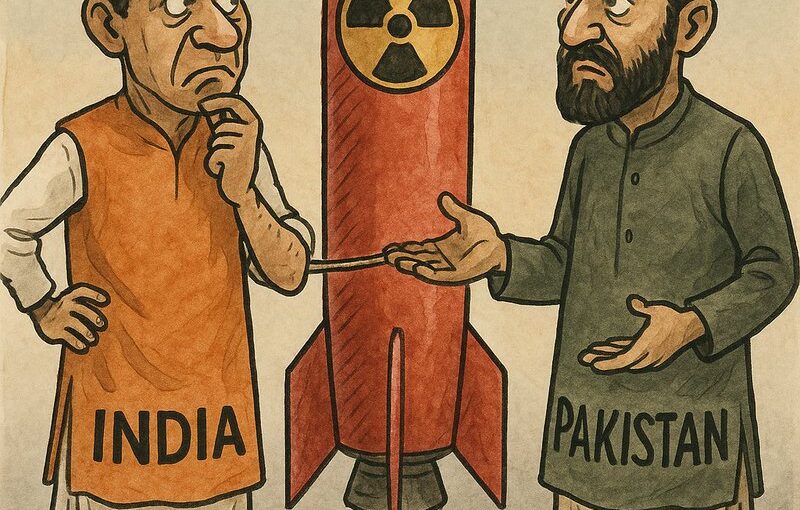
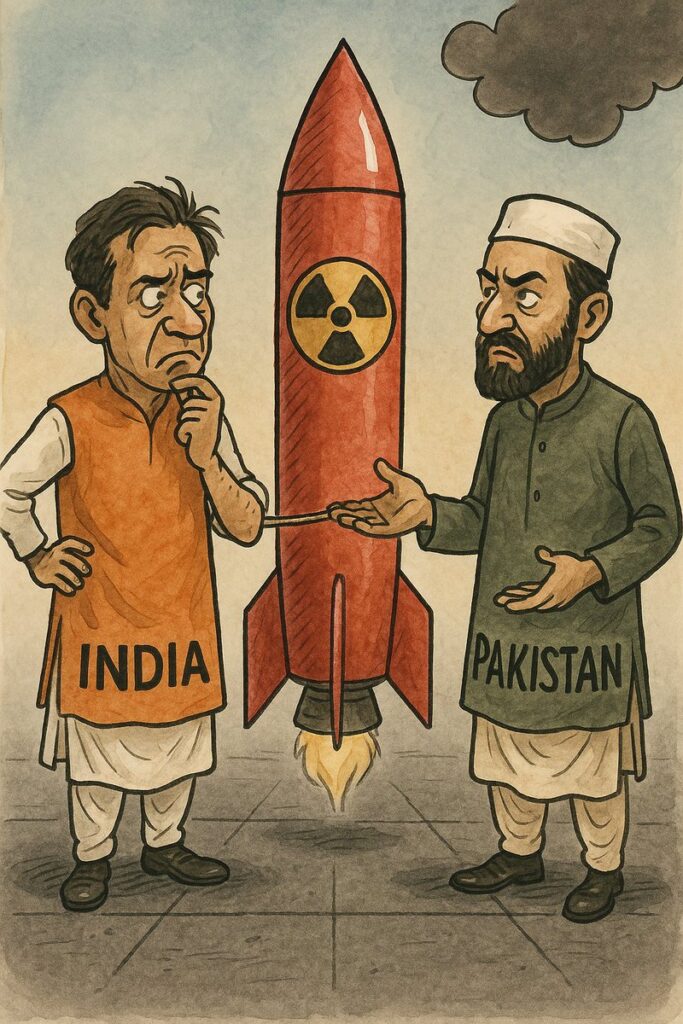
In the grand theater of geopolitics, few performances are as tragically repetitive as the India-Pakistan saga. The latest episode in this decades-long drama has once again brought two nuclear-armed neighbors to the precipice of disaster, with a fragile ceasefire currently holding by threads thinner than a politician’s promise.
The Ceasefire That Nobody Believes In
A week into the latest ceasefire, and already the spin machines are working overtime. Pakistan “welcomes” Donald Trump’s “mediation” — a claim that India dismisses faster than a cricket batsman facing a slow ball. India insists they halted hostilities purely out of the goodness of their hearts, responding to Pakistan’s desperate pleas. If diplomatic statements were subject to polygraph tests, we’d need machines with reinforced sensors.
Let’s be honest: this ceasefire isn’t a resolution; it’s merely an intermission. The tragic violence that sparked this round of hostilities hasn’t been addressed, and the fundamental causes remain as entrenched as ever.
Blood in Paradise
The spark that lit this particular powder keg was horrifyingly familiar. On April 22, the picturesque Pahalgam valley in Kashmir — a location whose beauty makes travel brochures weep with joy — became a scene of calculated brutality. Masked terrorists, with the cold efficiency of bureaucrats processing paperwork, separated tourists by religion and executed 26 non-Muslim men, mostly Hindus and Christians. Many were newlyweds, murdered in front of their wives who were deliberately spared to bear witness.
The Resistance Front quickly claimed responsibility — a group that India maintains is just another mask worn by Lashkar-e-Taiba (LeT), Pakistan’s not-so-secret terrorist proxy. It’s like claiming your destructive pet is actually a neighbor’s animal that just happens to sleep in your house, eat your food, and follow your commands.
The National Identity Crisis
Pakistan’s obsession with Kashmir is less about territory and more about existential validation. Born in 1947 as a homeland for the subcontinent’s Muslims based on the two-nation theory (the idea that Hindus and Muslims couldn’t coexist), Pakistan faced an immediate identity crisis when India stubbornly refused to become a Hindu state and instead embraced secularism.
Kashmir, with its Muslim majority, remains the uncomfortable contradiction in Pakistan’s national narrative. As long as millions of Muslims live contentedly (or at least legally) within India’s borders, Pakistan’s raison d’être faces an uncomfortable question mark. It’s like founding a club based on the premise that you can’t possibly associate with certain people, only to watch those very people form a more successful, inclusive organization next door.
Having failed to capture Kashmir through conventional warfare (0-3 in that particular contest), Pakistan switched to asymmetric warfare — terrorism by proxy. It’s a strategy that allows for perpetual conflict without the inconvenience of international condemnation that comes with open warfare.
Terrorism as Foreign Policy
Pakistan’s relationship with terrorist organizations is about as subtle as a neon sign in a monastery. One year after LeT orchestrated the 2008 Mumbai attacks, killing 166 people, the group’s leadership was supposedly “on trial” in Pakistan. The operative word being “supposedly.” When interviewed in Lahore (LeT’s hometown), a deputy of the group’s leader, Hafiz Saeed, could barely contain his amusement at the mention of legal proceedings. Three weeks later, Mr. Saeed was free as a bird, presumably to return to his day job of planning mass murder across the border.
This terror network isn’t some rogue operation; it’s Pakistan’s military-intelligence establishment’s masterpiece — their Afghanistan playbook repurposed. Unable to defeat India conventionally, Pakistan bleeds its larger neighbor through a thousand cuts, much like they helped do to the Soviets in Afghanistan. It’s warfare with plausible deniability, terrorism with a diplomatic fig leaf.
Self-Destructive Obsession
The tragedy of Pakistan’s Kashmir fixation isn’t just measured in Indian blood. Pakistan itself has been the greatest victim of its own policies. Its military, perpetually citing the existential threat from “Hindu India,” has gorged itself on the national budget for decades. Pakistan’s democracy resembles a game of musical chairs, with the army regularly stopping the music whenever a civilian government gets too comfortable.
Just days before the Pahalgam massacre, Pakistan’s military chief, General Asim Munir, was busy reinforcing this narrative, urging lawmakers to teach young Pakistanis that Muslims “are different from the Hindus in every possible aspect of life.” In most modern contexts, such rhetoric would be condemned as bigotry. In Pakistan, it’s constitutional bedrock, echoing the founding ideology of Mohammed Ali Jinnah.
The cost of this obsession? Pakistan’s economy is now 1/11th the size of India’s. While India has lifted 170 million people from extreme poverty in the past decade, Pakistan remains trapped in a cycle of economic crisis, foreign loans, and military dominance. It’s like refusing to fix your leaking roof because you’re too busy plotting to steal your neighbor’s garden gnome.
India’s Changing Calculus
For decades, India treated Pakistan’s provocations like an annoying younger sibling — irritating but ultimately not worth derailing the family dinner over. India focused on economic growth, global integration, and poverty reduction, absorbing terrorist attacks with a stoicism that sometimes bordered on fatalism.
Enter Narendra Modi in 2014, a Hindu nationalist who promised to change the equation. Interestingly, Modi initially invested significant political capital in peace with Pakistan — offering olive branches that were answered with grenades. After major terrorist attacks in 2016, Modi ordered military strikes. When terrorism continued — in 2019 and again this April — India’s responses grew bolder.
On May 7, Indian missiles destroyed nine sites allegedly housing “terrorist infrastructure.” When Pakistani military officials (curiously present at the funerals of UN-designated terrorists) escalated the situation, India struck military installations deep inside Pakistan, including the Nur Khan air base, practically in the shadow of Pakistan’s military headquarters.
India has taken losses too — at least two fighter jets — reminding us that even asymmetric conflicts have two sides. These losses are more than embarrassing; they’re dangerous. They risk creating a false sense of military parity that could delude Pakistan’s generals into believing they could sustain a conventional war with India — a miscalculation with potentially catastrophic consequences.
The Impossible Choice
So here we stand, watching two nuclear-armed nations circle each other like boxers who can’t afford to land a knockout punch. There are theoretically two paths to permanent peace: either India agrees to a second Partition and surrenders Kashmir on religious grounds, or Pakistan accepts the finality of the first Partition and abandons terrorism as state policy.
Neither option resides in the neighborhood of reality.
India, a constitutionally secular republic with the world’s third-largest Muslim population, cannot surrender territory based on religious demographics without undermining its foundational principles. For Pakistan, abandoning the Kashmir cause would require a fundamental reimagining of national identity and purpose — something its powerful military establishment has no interest in pursuing.
So India, despite its aspirations to global power status and economic prosperity, finds itself trapped in a geographic curse — living next to a nuclear-armed neighbor that has institutionalized terrorism as foreign policy. It’s a curse that can perhaps be mitigated but not eliminated.
The Nuclear Shadow
Hovering over this intractable conflict is the specter that makes it globally significant: nuclear weapons. Both countries have them, both countries have threatened to use them, and both countries have leadership elements that sometimes speak in apocalyptic terms.
The recent escalation brought these weapons back into public consciousness. When conventional strikes hit deep inside Pakistan territory, the whispers of nuclear retaliation grew temporarily louder. The world held its breath, and not for the first time.
The International Response
The international community’s response to this conflict follows a predictable pattern: expressions of “deep concern,” calls for “maximum restraint,” and urging “dialogue” between the parties. It’s diplomatic speak for “please don’t start a nuclear war while we’re busy with other problems.”
The United States, under President Trump’s second administration, has claimed credit for mediating the current ceasefire — a claim India firmly rejects. China, Pakistan’s “all-weather friend,” has made supportive noises toward Islamabad while carefully avoiding direct involvement. The rest of the world largely wants the problem to go away without having to choose sides.
A Future Without Resolution
The sad reality is that there is no resolution on the horizon. The fundamentals haven’t changed in 75 years, and they’re unlikely to change now. India will continue growing economically while bearing the burden of periodic terrorist attacks. Pakistan will continue its dangerous game of proxy warfare while its own development stagnates. Kashmiris caught in the middle will continue suffering.
Occasionally, violence will spike, international attention will briefly focus, ceasefires will be declared, and the cycle will reset until the next incident. It’s a geopolitical version of Groundhog Day, but with nuclear weapons.
The Bottom Line
So what’s the answer? Perhaps there isn’t one, at least not one that satisfies all parties. Perhaps the best-case scenario is management rather than resolution — keeping the conflict below the threshold of full-scale war while working to gradually reduce tensions.
For the moment, the ceasefire holds. Both countries have stepped back from the brink once again. But the underlying causes remain unaddressed, the wounds unhealed, and the cycle unbroken.
In the meantime, ordinary Indians and Pakistanis continue living their lives in the shadow of a conflict that has outlasted generations. They go to work, raise families, celebrate festivals, and hope for a better future — all while their governments remain locked in a dangerous dance that shows no signs of ending.
The tragedy isn’t just that there are no good solutions; it’s that there may be no solution at all. And that is perhaps the hardest truth to accept.
The views expressed in this article are those of the author and do not necessarily reflect the official policy or position of any agency or government.