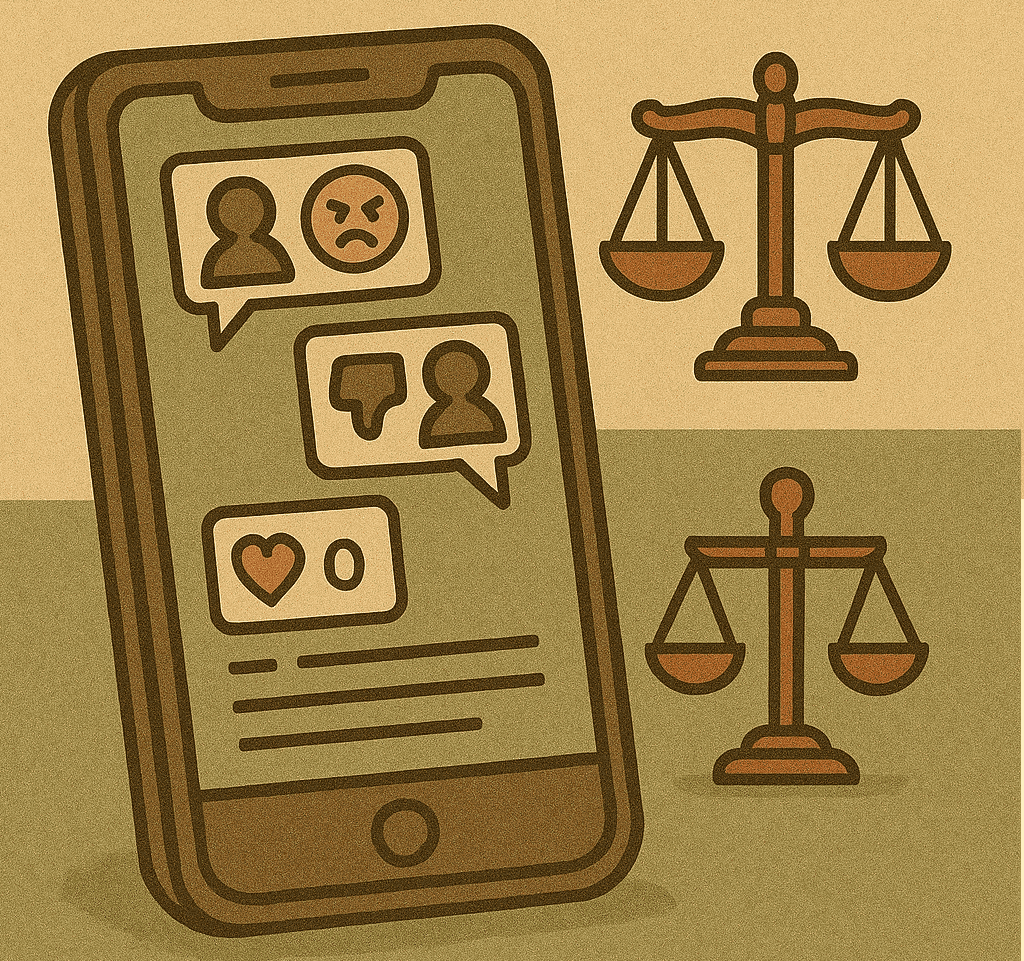
Social media is an integral part of modern life, fundamentally altering how we communicate and raising critical questions about the application of law in the digital sphere.1 In this digital age, platforms have revolutionized information sharing, drastically reshaping the landscape of defamation law.3 The unprecedented speed and global reach of online interactions create a complex environment where libel and slander can proliferate with alarming rapidity, often outpacing traditional legal frameworks.5
As individuals now wield the power of publishing through personal devices, distinguishing between protected free expression and harmful misinformation becomes increasingly challenging.8 This article examines how social media affects defamation law, which addresses false statements that harm someone’s reputation.12 It delves into the legal issues faced by both individuals and companies, reviewing recent court cases and evolving judicial attitudes.3 The focus is on the challenges courts encounter in protecting reputations while respecting the freedoms inherent in modern communication, particularly within the Indian legal context.20
What Is Defamation?
Defamation is the act of communicating false statements about someone that injure their reputation.22 Traditionally, it is divided into:
- Libel: Defamation in a permanent form, such as written or printed words, images, or online posts.12
- Slander: Defamation in a transient form, typically spoken words or gestures.12
In India, both libel and slander are treated as criminal offenses under Section 499 of the Indian Penal Code (IPC).29
Defamation Across Online Platforms
Defamation can occur on numerous social media and online platforms, including 6:
- Facebook 13
- Instagram 13
- LinkedIn 13
- TikTok 35
- Nextdoor
- Reddit 35
- Yelp 25
- X (formerly Twitter) 13
Defamatory content published on blogs or other online platforms is also subject to legal provisions.23 Bloggers can be held liable if their content damages someone’s reputation and meets the criteria outlined in Sections 499 and 500 of the IPC.23
Other examples of online defamation include:
- Leaving a false Google review (though honest opinions based on genuine experiences are generally protected as free speech).25
- Sharing a video with false comments or maliciously altered images.53
- Making defamatory public comments on media websites.33
- Writing defamatory letters to the editor (print or online).33
- Making defamatory remarks in WhatsApp chat groups.13
Consequences of Cyber Defamation
Online defamation, often termed cyber defamation, can have severe consequences 27:
- Damage to the victim’s personal or professional life.34
- Loss of job opportunities or business.34
- Mental health issues like emotional distress, anxiety, and depression.24
Requirements to Prove Defamation
To establish a defamation claim (civilly), a plaintiff generally must show 22:
- A False Statement Purporting to be Fact: The statement must be false and presented as a fact, not merely an opinion.22
- Publication: The statement must have been communicated (‘published’) to at least one third person.22
- Identification: The statement must reasonably be understood to refer to the plaintiff.17
- Harm: The statement must have caused harm to the plaintiff’s reputation.22
- Fault: The defendant must have acted with at least negligence regarding the statement’s truth or falsity.22 (Note: Criminal defamation in India requires intent or knowledge of harm 24).
Traditional Defamation Law Principles
Traditionally, defamation law balances the protection of reputation against the freedom of expression.22 The framework focuses on accuracy and fairness in public discourse.2 Key defenses against defamation claims include truth (justification), privilege (absolute or qualified), and fair comment on matters of public interest.22
Adapting these principles to social media is challenging due to the unique characteristics of digital communication:
- Speed and Reach: Information, true or false, spreads globally at unprecedented speeds, potentially causing widespread reputational harm before any response is possible.22
- Anonymity/Pseudonymity: Users can often hide their identities, making it difficult to hold perpetrators accountable.22
- Jurisdictional Issues: The borderless nature of the internet creates complexities in determining which country’s laws apply and which courts have authority.22
Social Media Defamation According To Indian Law
In India, defamation is uniquely treated as both a criminal offense and a civil wrong, allowing aggrieved parties to pursue both avenues.23
Criminal Defamation (IPC Sections 499 & 500)
- Section 499 IPC: Defines criminal defamation as making or publishing any imputation (spoken, written, signs, visible representations) concerning a person with the intent to harm their reputation, or knowing/believing it will cause harm.23 This includes imputations against companies or even deceased persons if intended to harm the family.23
- Exceptions: Section 499 includes ten exceptions where a statement, even if harmful, is not defamation. Key exceptions include truth published for the public good (First Exception – notably, truth alone is not sufficient) 29, fair comment on the conduct of public servants or on public questions (Second, Third Exceptions) 29, and statements made in good faith to protect interests (Ninth Exception).23
- Section 500 IPC: Prescribes the punishment for criminal defamation: simple imprisonment for up to two years, or a fine, or both.23 The offense is non-cognizable, bailable, and compoundable.24
- Constitutional Validity: The Supreme Court upheld the constitutionality of criminal defamation in Subramanian Swamy v. Union of India (2016), ruling that the right to reputation is part of the right to life (Article 21) and criminal defamation is a reasonable restriction on free speech (Article 19(1)(a)) under Article 19(2).24 However, it remains controversial, with critics arguing it chills free speech and is misused.24
Civil Defamation (Law of Torts)
- Basis: Governed by uncodified common law principles (Law of Torts).25
- Objective: To compensate the victim with monetary damages for reputational harm.24
- Elements: Plaintiff must prove a defamatory statement was made, it referred to them, it was published to a third party, and it caused harm.24
- Standard of Proof: Decided on the ‘balance of probabilities’ (lower threshold than criminal cases).65
- Defenses: Include truth (justification – generally sufficient without needing ‘public good’), fair comment, and privilege.24
Role of the Information Technology Act, 2000 (IT Act)
The IT Act provides the legal framework for electronic communications and significantly impacts online defamation:
- Section 469 IPC Amendment: The IT Act amended IPC Section 469 to explicitly include forgery of “electronic records” intended to harm reputation. This covers creating fake emails, social media profiles, or digitally manipulated content to defame someone, punishable by up to three years imprisonment and a fine.23
- Section 79 IT Act (Intermediary Liability): This crucial section provides a “safe harbour,” granting intermediaries (like social media platforms, ISPs) conditional immunity from liability for third-party content they host or transmit.29 Immunity is lost if the intermediary conspires in the unlawful act or fails to expeditiously remove unlawful content upon receiving “actual knowledge” (often interpreted as a court order or government notification following the Shreya Singhal case).27
- IT Rules (Intermediary Guidelines): The Information Technology (Intermediary Guidelines and Digital Media Ethics Code) Rules, 2021, detail the “due diligence” obligations for intermediaries to maintain safe harbour. This includes publishing user rules against defamatory content, establishing grievance redressal mechanisms, and mandating specific takedown timelines (e.g., 36 hours for certain content upon order/notification, 24 hours for non-consensual intimate images upon complaint).54 These rules aim to curb online harms but also raise concerns about potential over-censorship and impact on free speech.54
- Section 66A Repeal: Section 66A, which penalized “offensive” online messages, was struck down as unconstitutional by the Supreme Court in Shreya Singhal v. Union of India (2015) due to vagueness and its chilling effect on free speech.53 This landmark decision reinforced online free expression protections but means other laws (like IPC 499/500) are the primary recourse for online defamation.53
The Future of Defamation Law in the Social Media Era
The future of defamation law is intrinsically linked to the evolving social media landscape, necessitating a critical reassessment of existing legal frameworks.24 The speed, reach, and anonymity afforded by online platforms challenge traditional definitions and enforcement mechanisms.22
Addressing these challenges requires adaptive legal measures.22 Discussions include:
- Decriminalization: Ongoing debate about repealing criminal defamation (IPC 499/500) due to its chilling effect and potential for misuse, though the Subramanian Swamy ruling presents a barrier.73
- Intermediary Liability Reform: Refining Section 79 and the IT Rules to better balance platform immunity, user protection, and free speech, potentially with clearer obligations and enhanced procedural fairness for takedowns.30
- Jurisdiction and Anonymity: Developing clearer rules for cross-border cases and finding ways to address anonymous defamation while respecting privacy.22
- New Technologies: Adapting laws to address AI-generated defamation and deepfakes.24
- Procedural Reforms: Streamlining processes, exploring alternative dispute resolution, and potentially revisiting burdens of proof.24
Conclusion
The digital age, characterized by the instantaneous global spread of information and the empowerment of individuals as publishers, magnifies the complexities of defamation.22 Navigating the worlds of social media and blogging requires a keen understanding of the legal intricacies and ethical responsibilities tied to our digital voices.6 The potential for significant harm from false or destructive content is amplified online.13 Understanding the legal ramifications of defamation underscores the critical need for responsible expression and digital citizenship in maintaining a balance between protecting reputations and preserving the freedoms essential to modern communication.23