Digital users routinely enter into clickwrap contracts when interacting with online platforms, installing software, accessing online banking services, or completing any form of online registration. These contractual arrangements have become ubiquitous in the digital economy, often executed multiple times daily by individual users.
A clickwrap contract, also termed a click-through contract, may be defined as a contractual arrangement between a service provider and an online user, wherein the user must agree to the service provider’s terms and conditions before accessing any website or utilising any software. The distinguishing characteristic of a clickwrap contract is the requirement that users click on a designated box or button before they can install software or access a website. The clickwrap contract derives its conceptual origins from shrinkwrap contracts, wherein terms of service accompany physical packaging and the act of opening such packaging constitutes acceptance of the shrinkwrap contract.
Definition and Nature of Clickwrap Contracts
A clickwrap contract constitutes a category of digital contract. It represents an agreement between a user and a company, wherein the user must click a designated box or button before downloading content, completing a purchase, or accessing a website. The contract formation occurs at the moment of the user’s affirmative action in clicking the acceptance mechanism.
Essential Characteristics
Clickwrap contracts possess several defining characteristics that distinguish them from other contractual forms.
First, these contracts are unilateral in nature. They contain standardised terms and conditions to which multiple online users agree before accessing websites or products. The service provider drafts the terms without negotiation with individual users.
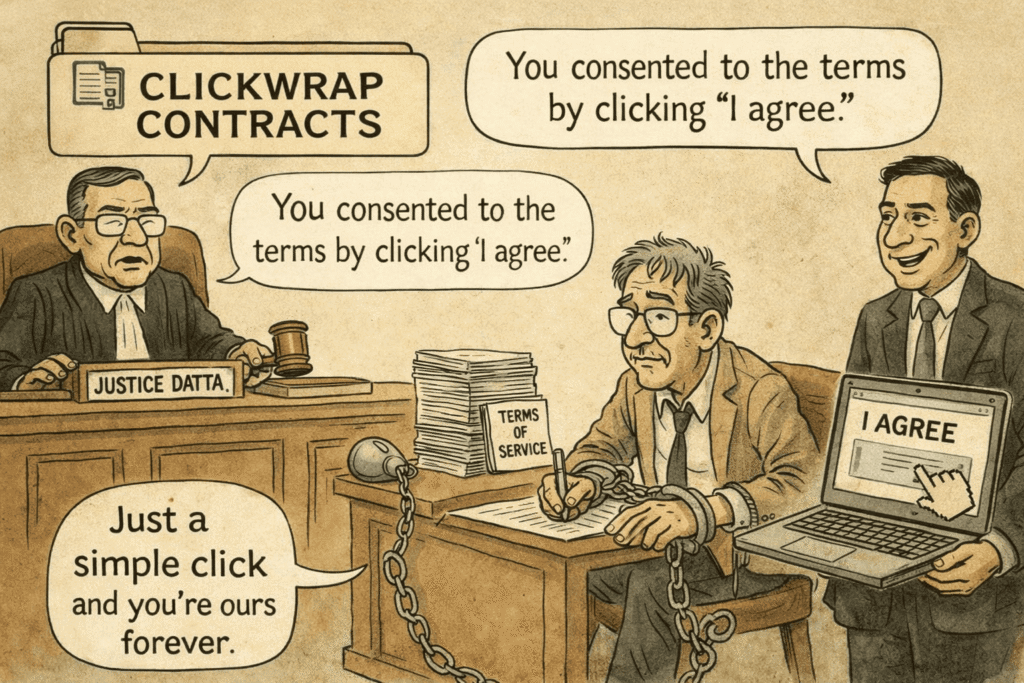
Second, clickwrap contracts are identifiable through their characteristic acceptance mechanisms, typically manifested as buttons bearing text such as “I accept,” “I agree,” “OK,” or “I consent.” These mechanisms require affirmative user action to proceed.
Third, the subject matter of clickwrap contracts typically encompasses terms and conditions of use, privacy-related provisions, or End-User Licence Agreements (EULAs). These documents govern the relationship between the service provider and the user throughout the duration of service utilisation.
Fourth, users retain the capacity to decline contractual formation by clicking cancel buttons, selecting “I disagree” options, or simply closing the website or application. This preservation of user choice is fundamental to the contract’s validity.
Commercial Significance
Clickwrap contracts serve a critical function in contemporary digital commerce, particularly within Business-to-Consumer (B2C) contexts. The substantial volume of user interactions with individual products or websites necessitated the development of efficient contractual mechanisms. While clickwrap contracts offer operational simplicity and time efficiency, they provide several additional commercial advantages.
The integration of these contracts within websites enables direct user access and downloadability of terms. Companies can simultaneously contract with multiple users without engaging in individual negotiations. Service providers may preserve electronic records of acceptance and incorporate additional clauses without prior user consultation. Beyond software applications, clickwrap mechanisms may be deployed across diverse contractual contexts. Furthermore, clickwrap contracts may govern relationships not only between companies and third parties but also between employers and employees, as demonstrated in ADP v. Lynch (Civ. No. 2:16-01053).
Legal Enforceability
International Jurisprudence
Given the widespread deployment of clickwrap contracts across digital platforms, questions regarding their enforceability in courts of law arise with regularity. The fundamental enquiries concern whether all clickwrap contracts may be enforced judicially and what positions international and Indian law adopt regarding these instruments.
Judicial pronouncements across multiple jurisdictions have established parameters for clickwrap contract enforceability.
In Feldman v. Google, Inc. (513 F. Supp. 2d 229, E.D. Pa. 2007), the court upheld clickwrap contract enforceability upon finding “reasonable notice of the terms and manifested assent of the Contract.” The plaintiff contended that no contractual relationship existed with the defendant. However, the court determined that purchase of advertising through the “AdWords” programme was impossible without agreeing to the contractual terms and conditions.
In Specht v. Netscape Communications Corporation (306 F.3d 17, 2d Cir. 2002), the court held that clickwrap contracts are enforceable only when clearly and conspicuously posted on the website. In the instant case, Netscape had posted the contract inconspicuously, rendering it unenforceable.
In Bragg v. Linden Research, Inc. (487 F. Supp. 2d 593, E.D. Pa. 2007), the court acknowledged proper contract design but found that Linden Research had exploited unequal bargaining power by crafting oppressive, unconscionable terms. This rendered the contract unenforceable notwithstanding its proper formal structure.
In Hotmail Corporation v. Van Money Pie (1998 WL 388389, N.D. Cal.), the court held that clicking the “I agree” button at the conclusion of terms and conditions establishes clickwrap contract enforceability.
These judicial pronouncements collectively establish that clickwrap contracts possess international enforceability in courts of law, subject to satisfaction of specified conditions.
Indian Legal Position
Indian jurisprudence has addressed the validity of adhesion contracts and electronic agreements through several significant pronouncements.
In LIC India v. Consumer Education and Research Centre (1995 AIR 1811), the Supreme Court of India examined the scope of judicial intervention in contracts characterised by unequal bargaining power between parties. The Court held that where a contract may be characterised as an adhesion contract and parties lack equal bargaining power, Article 14 of the Constitution of India (guaranteeing equal protection of law) empowers the Supreme Court to strike down unfair or unreasonable contractual provisions.
In Trimex International FZE v. Vedanta Aluminium Limited, the court upheld that where contractual terms have been discussed via electronic mail, such communications constitute a valid and enforceable contract.
In DDIT (IT) Mumbai v. Gujarat Pipavav Port Ltd., the Income Tax Tribunal held that unconscionable or unreasonable bargains (contracts of adhesion) in mass contracts such as shrinkwrap and clickwrap agreements render them unenforceable, notwithstanding satisfaction of all constituent elements of a valid contract.
Statutory Framework in India
The Indian Contract Act, 1872, does not expressly encompass electronic contracts or clickwrap contracts within its definitional provisions. The Information Technology Act, 2000, provides recognition for electronic contracts through Section 10-A (effective from 27 November 2009). Additionally, the United Nations Commission on International Trade Law (UNCITRAL) Model Law on Electronic Commerce validates electronic signatures. However, neither framework expressly addresses acceptance mechanisms such as “I agree,” “I accept,” or “OK” buttons.
Section 65-B of the Indian Evidence Act, 1872, establishes procedures for furnishing electronic documents as evidence. However, this provision has not been judicially applied in the context of clickwrap or similar contracts. Consequently, clickwrap contracts cannot definitively be characterised as “electronically signed” within the Indian legal context. Nevertheless, no Supreme Court pronouncement has held clickwrap contracts invalid in India.
The judicial authorities outlined above demonstrate that clickwrap contracts are enforceable in courts of law, with enforceability substantially dependent upon whether consent was obtained freely and actively. While all clickwrap contracts may be enforced if they satisfy the essential elements of valid contracts, international jurisdictions have accorded greater recognition to these instruments than Indian law has to date.
Best Practices for Clickwrap Contract Design
International litigation has generated guidance on best practices for ensuring clickwrap contract enforceability.
Active User Consent: The requirement of active user consent constitutes a fundamental best practice. Users must affirmatively click designated buttons bearing text such as “I agree,” “OK,” or “I accept.” Websites should not pre-select acceptance boxes, as user assent must be actively and voluntarily manifested.
Screen Design Considerations: Optimal screen layout for terms and conditions should be simple and uncluttered. The entire content should be visible on a single screen. Language should be readily comprehensible to users. Contrasting colours that may obscure text should be avoided.
Reasonable Termination Notice: Users should receive clear notification regarding terms of service. Headings such as “Terms and Conditions,” “Privacy Policy,” and “User Contract” should be displayed in fonts that are easily readable and comprehensible by users. Clear notice of contractual terms enhances enforceability in courts of law.
Layperson Comprehensibility: Website operators and software providers should recognise that not all users possess legal sophistication. Clickwrap contracts should be drafted in language that persons without privacy or legal backgrounds can read, comprehend, and to which they can provide informed consent. Websites should explicitly encourage users to read the terms of service.
Re-consent for Revised Terms: Where terms of service are revised, users should be required to accept the updated terms anew. This ensures user awareness of modified service conditions.
Highlighted Specific Consents: Where service providers seek permission for matters such as use of personal information or marketing purposes, such specific terms should be visually distinguishable from the remainder of the document.
Documentation and Record-Keeping: Maintaining comprehensive records constitutes one of the most critical elements of clickwrap contract enforcement. Records should capture when consent was obtained and which version of the contract received acceptance. Absent proof of who accepted the contract and which version was accepted, clickwrap contracts are unlikely to be enforceable.
Conclusion
The legal validity of clickwrap contracts has been established across numerous jurisdictions. Countries including the United States, the United Kingdom, and European nations have enacted legislation specifically addressing these instruments. However, the legal validity of clickwrap contracts within the Indian context remains underdeveloped. Given the expanding utilisation of such contracts in digital commerce, Indian law has not kept pace with the governance requirements these instruments present. Incorporation of clickwrap contract provisions within the existing Information Technology Act, 2000, or introduction of dedicated legislation addressing online software contracts would benefit online users. Statutory recognition not only validates these instruments but also provides protection against exploitation through unconscionable bargaining power (contracts of adhesion) by service providers.
Among the various forms of digital contracts, including clickwrap, shrinkwrap, and browsewrap agreements, clickwrap contracts represent the optimal mechanism. This superiority derives from the requirement of active user consent, as opposed to other contractual forms where implied use of a website or software is deemed valid consent. Given the increasing deployment of clickwrap contracts across digital platforms, implementation of established best practices ensures these contracts remain enforceable in judicial proceedings.
This article presents legal analysis for educational purposes. Specific legal matters should be addressed through consultation with qualified legal professionals.