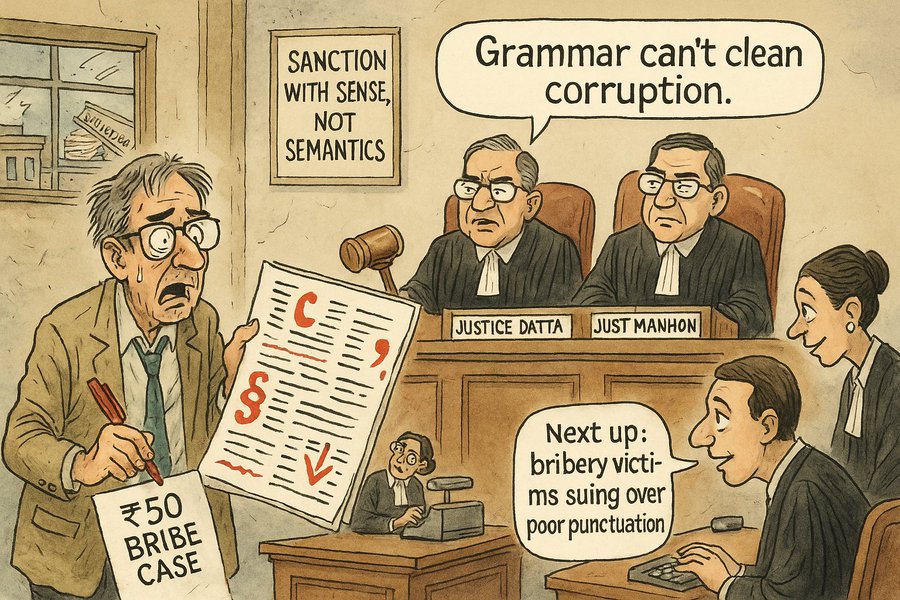
In a ruling that might disappoint grammar pedants everywhere, the Supreme Court has declared that minor edits don’t constitute a get-out-of-jail-free card for corrupt officials.
The Case of the Contested Commas
The Supreme Court recently dashed the hopes of a retired public servant who apparently believed that a red pen might accomplish what his defense counsel couldn’t. The official, convicted of accepting a modest ₹500 bribe back in 2000 (barely enough for a decent coffee these days), had pinned his acquittal hopes on alleged irregularities in the sanction order that authorized his prosecution.
Justices Dipankar Datta and Manmohan, clearly unimpressed by this editorial defense strategy, ruled that the minor tweaks made to the sanction report merely ensured its form matched its substance—a bit like adjusting your tie without changing your entire outfit.
Substance Over Style: The Court’s View
“If a draft order is placed before the sanctioning authority and he is satisfied that nothing needs to be added/deleted therefrom, the grant of sanction cannot be faulted merely on the ground of absence of addition of words to/deletion of words from the draft,” the Court declared, in what might be history’s most meta judicial statement about editing.
In essence, the Court concluded that the sanctioning authority had properly applied their mind before issuing the order—a refreshing assessment in bureaucratic circles, where “applying one’s mind” isn’t always a given.
The ₹500 Question
The case itself dates back to 2004 when a Special Court convicted the appellant for demanding and accepting a ₹500 bribe to expedite land record extracts. The Bombay High Court affirmed this conviction in September 2024, presumably after spending two decades contemplating the philosophical implications of a ₹500 bribe in an increasingly inflationary economy.
Before the Supreme Court, the appellant argued procedural flaws, including an allegedly “mechanical” sanction for prosecution—as if rubber stamps weren’t a time-honored tradition in government offices.
The Fine Print of Justice
Justice Datta, who authored the judgment, emphatically rejected claims that the sanction was granted without application of mind. The Court noted that sanctions exist to protect honest officials, not to provide a syntactical escape hatch for the dishonest ones.
“There is a legal impediment to prosecute a public servant for corruption, if there be no sanction,” the Court observed, before clarifying that all a sanctioning authority needs is to be satisfied about the existence of a prima facie case—not absolute certainty about every crossed ‘t’ and dotted ‘i’.
The Grammar of Corruption
Citing precedent from Manzoor Ali Khan v. Union of India, the bench emphasized that while procedural safeguards are important, they cannot become technical loopholes through which corruption slips unchecked.
“Even otherwise, merely because there is any omission, error or irregularity in the matter of granting sanction, that does not affect the validity of the proceedings unless the court records its own satisfaction that such error, omission or irregularity has resulted in a failure of justice,” the Court observed, essentially telling corruption defendants that their spell-check defense strategy needs a serious upgrade.
The Moral of the Story
In what might be considered a judicial version of “substance over form,” the Supreme Court has made it clear that minor alterations in a report, without any prejudice to substantial justice, don’t render a sanction order invalid.
For public servants contemplating similar appeals based on clerical technicalities, the message is crystal clear: editorial critiques won’t save you from corruption charges. Perhaps it’s better to simply avoid accepting bribes—even ones that wouldn’t cover a movie ticket in 2025’s economy.
The appellant, represented by Ms. Meenakshi Arora, senior counsel, might now be contemplating that ₹500 was an extremely expensive bribe—not for what it bought, but for what it ultimately cost.
Case Title: DASHRATH VERSUS THE STATE OF MAHARASHTRA