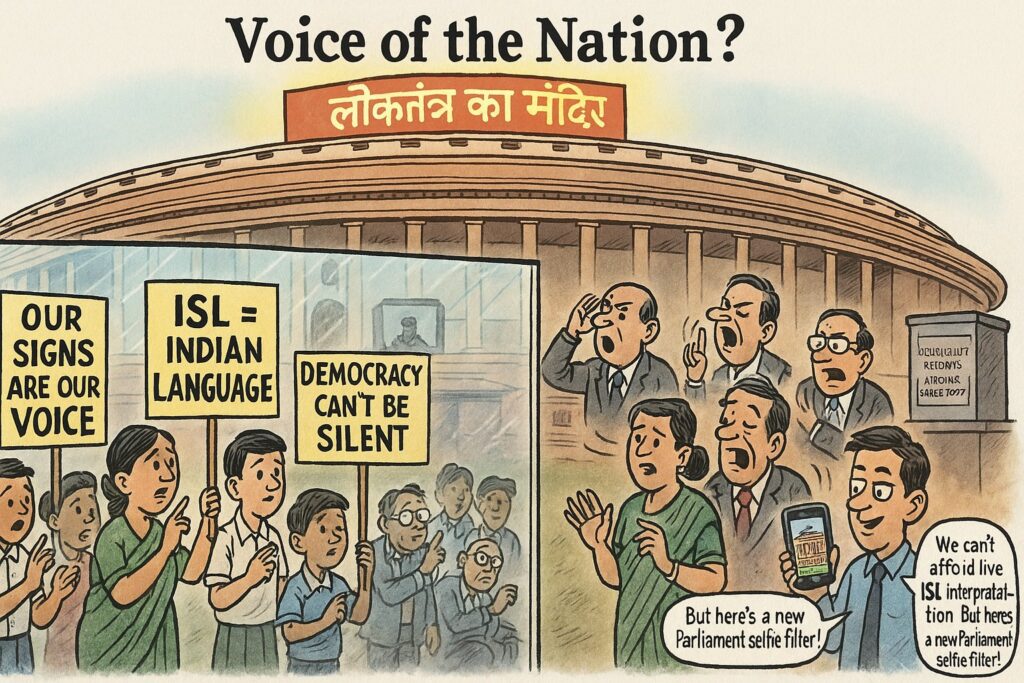
You’re trying to have a crucial conversation about your future, your rights, your very existence—but the person you’re talking to has their fingers in their ears, humming loudly. Now imagine that person is your democracy.
Welcome to the reality faced by millions of deaf and hard-of-hearing citizens worldwide, where the halls of power might as well be soundproof chambers designed to keep certain voices—or rather, certain hands—from joining the conversation.
The Great Parliamentary Pantomime
Our modern democracies pride themselves on being bastions of representation and inclusion. Politicians wax lyrical about being the “voice of the people,” but here’s the kicker: what happens when your voice speaks through signs rather than sounds? Suddenly, that meticulously crafted democratic machinery starts looking less like a well-oiled machine and more like a members-only club with a strict “No Hands Allowed” policy—unless you’re applauding, of course.
The irony is almost too perfect to be real. In chambers designed for debate, discussion, and the free exchange of ideas, we’ve somehow managed to create a system that systematically excludes those who communicate through the world’s most expressive medium: sign language. It’s as if we’ve built the world’s most sophisticated telephone system and forgotten that not everyone can hear the dial tone.
The Constitutional Conundrum
Here’s where things get legally spicy. Most democratic constitutions guarantee freedom of expression and the right to information. They’re beautiful documents, really—pages upon pages of rights and protections that would make any civil libertarian weep tears of joy. But there’s a catch, and it’s a big one: these rights assume you can access the very forums where they’re discussed, debated, and decided upon.
It’s like being invited to a dinner party where the menu is written in invisible ink. Sure, you’re technically included, but good luck figuring out what’s being served.
The legal gymnastics required to justify this exclusion would make even the most flexible constitutional lawyer pull a muscle. How do we square the circle of claiming universal representation while simultaneously making our most important democratic institution inaccessible to millions? The answer, it seems, is we don’t—we just hope nobody notices the contradiction.
The Technology Excuse That Isn’t
“But it’s too technically challenging!” cry the parliamentary administrators, clutching their pearls and their outdated broadcasting equipment. This argument might have held water in, say, 1975. But in an age where we can live-stream from Mars and run entire businesses from our phones, claiming we can’t add sign language interpretation to a video feed is like saying we can’t put wheels on a cart because we haven’t invented the circle yet.
The technology exists. It’s not just available; it’s embarrassingly simple. We’re not asking for holographic translators or AI-powered sign language robots (though those would be cool). We’re asking for what essentially amounts to picture-in-picture technology—something your grandmother’s TV from 1995 could handle.
The Global Report Card: Who’s Signing, Who’s Slacking
Let’s take a world tour of parliamentary accessibility, shall we? Spoiler alert: it’s not pretty.
New Zealand gets a gold star—they’ve had sign language interpretation in Parliament since 2006. Not coincidentally, they also recognized New Zealand Sign Language as an official language that same year. It’s almost as if treating a language as legitimate leads to actually using it in important places. Revolutionary concept, I know.
The United Kingdom stumbles along with sporadic interpretation for major events but falls short of comprehensive coverage. It’s like they’re saying, “We’ll include you, but only for the highlight reel.”
The United States Congress? Don’t make me laugh. In a country that prides itself on accessibility laws, the highest legislative body remains stubbornly monolingual in its broadcast approach. The Americans with Disabilities Act apparently stops at the Capitol steps.
The Cost-Benefit Analysis Nobody Wants to Do
“It’s too expensive!” comes the next cry from the budget hawks. Ah yes, the cost argument—the last refuge of those who’ve run out of real excuses. Let’s crunch some numbers, shall we?
The average cost of adding sign language interpretation to a broadcast is roughly equivalent to what most parliaments spend on coffee and biscuits for a month. We’re not talking about building a new wing; we’re talking about hiring qualified interpreters and adding a small video overlay.
But let’s flip the script: what’s the cost of excluding millions of citizens from democratic participation? How do you quantify the loss of civic engagement, the erosion of trust, the fundamental disconnect between the governed and their government? Suddenly that interpreter’s salary starts looking like the bargain of the century.
The Deaf Community: Not Silent, Just Unheard
Here’s the thing about the deaf community: they’re anything but silent. They’re vibrant, vocal (in their own way), and politically engaged. They march, they advocate, they organize. They do everything we expect active citizens to do—except they do it in a language that makes certain people uncomfortable because it doesn’t involve sound waves.
The cruel irony is that sign languages are among the most expressive and nuanced forms of human communication. They convey emotion, emphasis, and subtlety in ways that spoken language often struggles to match. Yet we’ve decided that our parliaments—places supposedly dedicated to passionate debate and eloquent expression—should remain off-limits to this rich form of discourse.
The Ripple Effect: Democracy’s Echo Chamber
When we exclude deaf citizens from parliamentary observation, we don’t just limit their access—we impoverish our entire democratic discourse. Every perspective we shut out, every voice (or hand) we ignore, makes our democracy a little less representative, a little less legitimate.
It creates a cascade effect. Young deaf children grow up knowing that the most important discussions in their country happen in places they cannot fully access. Is it any wonder that political disengagement becomes a self-fulfilling prophecy?
The International Legal Framework: Pretty Words, Ugly Reality
The UN Convention on the Rights of Persons with Disabilities is a masterpiece of international law. Article 21 specifically addresses the right to freedom of expression and access to information. Article 29 guarantees political participation. Countries around the world have signed it, ratified it, and promptly filed it away in the “good intentions” drawer.
The gap between our international commitments and our domestic realities is wide enough to drive a parliamentary motorcade through. We’re excellent at making promises on the global stage, less excellent at following through when the cameras are off.
The Path Forward: Solutions That Sign
So what’s the fix? It’s surprisingly straightforward:
First, recognize sign languages as official languages. Not honorary, not special status—official. If it’s good enough for millions of citizens to use daily, it’s good enough for parliament.
Second, implement comprehensive interpretation for all parliamentary proceedings. Not just the big speeches, not just the highlight moments—everything. Democracy doesn’t happen only during prime time.
Third, train and employ qualified interpreters. This isn’t a job for volunteers or well-meaning amateurs. Professional interpretation requires skill, stamina, and deep cultural understanding.
Fourth, make accessibility the default, not the exception. Stop treating inclusion as an add-on feature and start seeing it as fundamental architecture.
The Digital Age Advantage
Here’s where it gets exciting. Digital broadcasting and streaming technology have made accessibility easier than ever. We can offer multiple language tracks, customizable viewing options, and on-demand interpretation. The technical barriers that might have existed decades ago have evaporated like morning dew.
We’re living in an age where you can get real-time translation of spoken languages on your phone. Surely, we can manage to put a sign language interpreter in the corner of a parliament broadcast?
The Cultural Shift: From Accommodation to Integration
The real challenge isn’t technical or financial—it’s cultural. We need to stop seeing sign language interpretation as an accommodation and start seeing it as an integral part of how democracy functions. It’s not about being nice or charitable; it’s about being complete.
Imagine if we broadcast parliament in only one spoken language and told speakers of all other languages to just figure it out. There would be riots. Yet we do exactly this with sign languages and call it normal.
The Business Case for Democracy
Here’s an argument that might resonate with the economically minded: accessible democracy is good for business. When citizens feel included and engaged, they participate more fully in all aspects of society, including the economy. Exclusion breeds disengagement, and disengagement is expensive.
Countries that have embraced sign language accessibility report higher levels of civic participation among deaf citizens, better educational outcomes, and stronger social cohesion. It turns out that when you actually include people, they contribute more. Who knew?
The Momentum Is Building
The tide is turning, albeit slowly. Advocacy groups are getting louder (in every sense), legal challenges are mounting, and public opinion is shifting. The question isn’t whether parliaments will become fully accessible, but when and how gracefully they’ll make the transition.
The smart money is on the early adopters—the countries that recognize the writing on the wall (or the signing in the air) and move proactively to include all their citizens. The laggards will eventually be dragged along, but not before embarrassing themselves on the international stage.
The Bottom Line: Democracy That Speaks Everyone’s Language
Democracy is supposed to be a conversation. Not a monologue, not a lecture—a conversation. And conversations require that all parties can understand and be understood. When we exclude sign language users from parliamentary observation, we’re not just failing them; we’re failing the fundamental promise of democratic governance.
The solution isn’t complicated. It doesn’t require revolutionary technology or astronomical budgets. It requires something far more challenging: the willingness to see democracy as truly belonging to everyone, regardless of how they communicate.
When democracy doesn’t sign back, it’s not being silent—it’s being silencing. And in the grand theater of parliamentary democracy, that’s the one performance we can no longer afford to give.
The curtain is rising on a new act, one where every citizen has a front-row seat and nobody needs to strain to understand what’s happening on stage. The only question is: will our parliaments learn their lines in time?
Democracy that excludes is democracy that fails. It’s time to sign a new social contract—one that actually includes all the signatures.