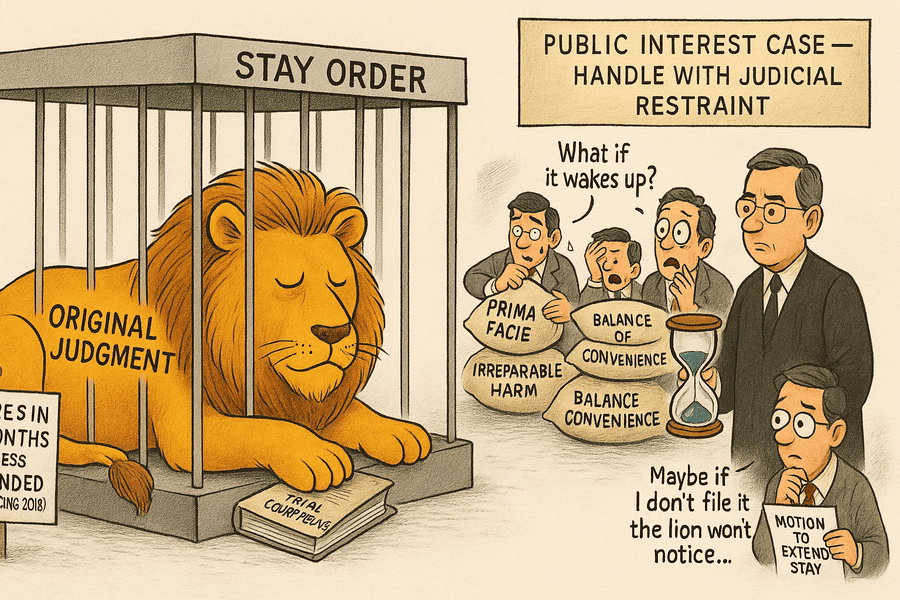
Stay orders are temporary judicial interventions that pause enforcement of lower court judgments while appeals are pending, not permanent dismissals. Indian courts grant stays only when specific conditions are met: prima facie case, balance of convenience, and irreparable injury. As established in Asian Resurfacing (2018), stays automatically lapse after six months unless extended with recorded reasons. The Supreme Court emphasizes judicial restraint in granting stays, particularly in public interest matters. While stays preserve status quo and prevent irreparable harm during proceedings, they don’t determine case merits. Once vacated, the original judgment becomes immediately enforceable – a “sleeping lion that awakens.”
A stay order temporarily suspends the effect of a ruling, preserving the status quo while legal proceedings continue
The Indian judicial system, with its hierarchical structure of courts, provides various remedies to ensure justice and prevent irreparable harm during the pendency of legal proceedings. Among these remedies, the concept of ‘stay orders’ holds particular significance. Often misunderstood as a permanent solution, stay orders are essentially temporary judicial interventions that suspend the operation of a judgment, order, or legal proceeding while the matter is under review by a higher court.
Understanding the Nature of Stay Orders
A stay order is fundamentally different from a dismissal or quashing of a lower court’s decision. While the latter permanently invalidates a judicial pronouncement, a stay merely puts it on hold. This distinction was eloquently clarified by the Supreme Court in Asian Resurfacing of Road Agency Pvt. Ltd. v. Central Bureau of Investigation (2018) 16 SCC 299, where the Court observed that “a stay order does not render a decision of the lower court a nullity; it only suspends the enforceability of the order/judgment.”
The temporary nature of stay orders is rooted in the principle of maintaining status quo ante, preventing any party from suffering irreparable injury during the pendency of proceedings. The Supreme Court in Mulchand Deva Ram Chawla v. State of Gujarat (1974) 3 SCC 698 held that “the very purpose of a stay order is to preserve the subject matter of the appeal and to ensure that the appeal, if successful, is not rendered infructuous.”
Legal Framework Governing Stay Orders
The power to grant stay orders derives from multiple statutory provisions and inherent powers of courts. Under the Civil Procedure Code, 1908, Order XLI Rule 5 specifically empowers appellate courts to stay proceedings in execution of decrees. Section 151 of the CPC also provides inherent powers to courts to make such orders as may be necessary for the ends of justice.
In criminal matters, Section 397 read with Section 401 of the Code of Criminal Procedure, 1973, empowers High Courts and Sessions Courts to stay orders of subordinate courts during revision proceedings. Similarly, Article 226 and Article 227 of the Constitution vest High Courts with supervisory jurisdiction, including the power to grant interim stay orders.
The Supreme Court, under Article 136 of the Constitution, exercises its special leave jurisdiction and frequently grants stay orders pending final disposal of special leave petitions. In Gangadhar v. Raghunath (1981) 4 SCC 103, the Supreme Court emphasized that “the power to grant interim relief, including stay orders, is incidental to the main power of the Court to do complete justice between the parties.”
Conditions for Granting Stay Orders
Courts do not grant stay orders mechanically or as a matter of routine. The Supreme Court in Shiv Shakti Coop. Housing Society v. Swaraj Developers (2003) 6 SCC 659 laid down three essential conditions for granting stay:
- A prima facie case in favor of the applicant
- Balance of convenience tilting in favor of the applicant
- Irreparable injury likely to be caused if stay is not granted
The Court further clarified that these conditions are cumulative and not alternative. The mere filing of an appeal or revision petition does not automatically entitle a party to a stay order. In Atma Ram v. State of Punjab (1959) SCR 1 SC, the Supreme Court held that “stays should be granted only in exceptional circumstances and not as a matter of course.”
Duration and Limitations of Stay Orders
Recognizing that prolonged stays can defeat the purpose of justice, courts have imposed temporal limitations on stay orders. The Supreme Court in Asian Resurfacing of Road Agency (supra) directed that any stay granted by any court, including the High Court, shall automatically lapse after six months unless extended for good reasons to be recorded in writing.
This landmark judgment aimed to prevent the misuse of stay orders, which often resulted in cases remaining pending for years. The Court observed that “stay orders cannot be allowed to operate indefinitely and defeat the very purpose of expeditious disposal of cases.”
In Commissioner of Central Excise v. Dunlop India Ltd. (1985) 1 SCC 260, the Supreme Court held that interim orders should not be continued mechanically without considering changed circumstances. The Court emphasized that “an interim order which was passed at an earlier stage may require modification or vacation in view of subsequent developments.”
Stay Orders versus Merits of the Case
It is crucial to understand that granting a stay order does not reflect upon the merits of the main case. The Delhi High Court in Rajiv Mehrotra v. Suresh Mehrotra 175 (2010) DLT 289 clarified that “grant of stay is not a reflection on the merits of the case, but is aimed at preserving the subject matter and preventing prejudice to parties during pendency of proceedings.”
The distinction between interim relief and final adjudication was highlighted by the Supreme Court in State of Maharashtra v. Digambar (1995) 4 SCC 683, where it held that “while granting interim relief, the Court does not decide the controversy on merits but merely preserves the property in dispute to await the final outcome of the proceedings.”
Vacation and Modification of Stay Orders
Stay orders, being temporary in nature, are subject to vacation or modification. The Supreme Court in M/s. Transcore v. Union of India (2006) 6 SCC 224 held that “a party can always approach the Court for vacation or modification of stay orders if there is change in circumstances or if the stay is being misused.”
Courts have inherent power to recall or modify their own orders, including stay orders. In Grindlays Bank Ltd. v. Income Tax Officer (1980) 2 SCC 191, the Supreme Court observed that “the power to grant stay necessarily implies the power to vacate or modify it when circumstances warrant such action.”
Impact on Lower Court Proceedings
When a stay order is issued, the proceedings or execution of orders of lower courts are temporarily suspended, but the original judgment remains intact. The Supreme Court in Kunhayammed v. State of Kerala (2000) 6 SCC 359 clarified that “a stay order does not wipe out the order of the lower court; it only suspends its operation.”
This principle ensures that if the appeal or revision is dismissed, the original order springs back to life without requiring any fresh proceedings. The Karnataka High Court in Smt. Leelavathi v. M. Chandrashekar ILR 2006 KAR 3426 aptly noted that “a stayed order is like a sleeping lion which wakes up the moment stay is vacated.”
Stay Orders in Different Jurisdictions
The principle that stay orders are temporary measures is consistent across various branches of law. In taxation matters, the Supreme Court in Commissioner of Income Tax v. Vallabh Glass Works Ltd. (1983) 2 SCC 410 held that “stay of recovery proceedings does not amount to stay of assessment; the assessment order remains valid and enforceable once the stay is lifted.”
In service law jurisprudence, the Supreme Court in State of Uttar Pradesh v. Brahm Datt Sharma (1987) 2 SCC 179 observed that “stay of operation of an order of punishment does not amount to setting aside the order; it merely postpones its implementation.”
Judicial Restraint in Granting Stays
Courts have increasingly emphasized the need for judicial restraint in granting stay orders. The Supreme Court in Siliguri Municipality v. Amalendu Das (1984) 2 SCC 436 cautioned that “courts should be extremely careful and circumspect in granting stay orders as they tend to upset the normal course of administration of justice.”
The principle of judicial restraint is particularly important in matters involving public interest. In State of Karnataka v. State of Tamil Nadu (2017) 3 SCC 362, the Supreme Court held that “while considering stay applications in matters of public importance, courts must balance private interests against larger public good.”
Abuse of Stay Orders and Judicial Response
The Indian judiciary has been cognizant of the potential misuse of stay orders. In T.N. Godavarman Thirumulpad v. Union of India (2006) 1 SCC 1, the Supreme Court expressed concern over the “stay order culture” and emphasized the need for stricter scrutiny before granting stays.
To prevent abuse, courts have started imposing conditions while granting stays. In Deccan Airways Ltd. v. Air Aviation Inter-City Services (1986) 3 SCC 423, the Supreme Court upheld the practice of imposing monetary conditions or requiring security deposits while granting stay orders.
Conclusion
The jurisprudential understanding of stay orders in India clearly establishes their temporary and provisional nature. They serve as a crucial tool for preserving the rule of law and preventing irreparable harm during the pendency of legal proceedings. However, they are not and cannot be construed as permanent relief or as a judgment on the merits of the case.
The evolution of judicial thinking on stay orders reflects a careful balance between providing necessary interim relief and ensuring that justice is not delayed indefinitely. The recent trend of imposing time limits on stay orders and requiring periodic review demonstrates the judiciary’s commitment to preventing their misuse while maintaining their effectiveness as a tool for interim relief.
As the Supreme Court eloquently stated in Mohd. Mehtab Khan v. Khushnuma Ibrahim Khan (2013) 9 SCC 221, “Stay is a temporary phase. It is an order to preserve the status quo till the matter is finally decided. It does not determine any right and is meant only to grant temporary relief.” This fundamental principle continues to guide the Indian judiciary in its approach to stay orders, ensuring that they remain true to their intended purpose as temporary judicial interventions rather than permanent solutions.
The clear jurisprudential position is that stay orders are bridges, not destinations – they facilitate the journey to justice but are not the final resting place of judicial determination. Understanding this distinction is crucial for both legal practitioners and litigants in navigating the Indian judicial system effectively.